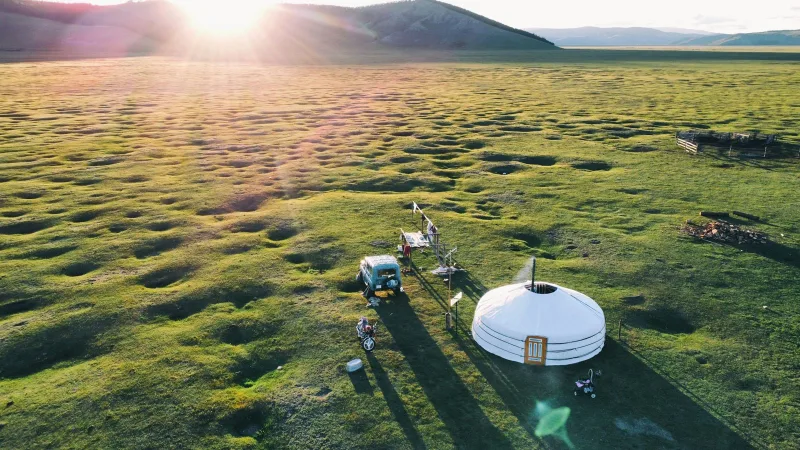
Mongolia is one of the few places left on earth that still feels genuinely unfinished. A Mongolia trip from India takes you to a country where the population is thinner than the horizon, the roads are suggestions, and staying overnight means sleeping in a round felt tent on a steppe that runs for hundreds of kilometres in every direction. No beach clubs, no guided bus tours, no Instagram crowds. Just enormous silence and the occasional eagle hunter. This guide covers everything an Indian traveller needs to know: visas, realistic costs in INR, a workable 10-day itinerary, and what the experience actually feels like.
Can Indians Travel to Mongolia Without a Visa?
Mostly yes, with one important detail. Indian passport holders can enter Mongolia visa-free for stays of up to 30 days. You land at Chinggis Khaan International Airport in Ulaanbaatar, present your valid Indian passport, and you are through. No e-visa form to fill, no pre-approval needed for a standard trip.
If your stay exceeds 30 days, you will need to register with the Mongolian Immigration Agency in Ulaanbaatar. For a 10 to 14-day trip, registration is not relevant.
Keep your passport valid for at least six months beyond your travel dates and carry proof of onward travel. That is it. For an Indian passport, Mongolia is one of the easier countries to enter in the entire Central Asian region.
Flights From India to Ulaanbaatar: What You Will Pay
There are no direct flights from India to Ulaanbaatar (airport code ULN). Every route connects through a hub. The most common layover cities are Beijing, Seoul, Moscow and Hong Kong.
Common routes and rough 2026 return-fare ranges:
| Route | Layover City | Approx. Return Fare (INR) |
|---|---|---|
| Delhi to ULN | Beijing (Air China) | Rs 65,000 to Rs 90,000 |
| Delhi to ULN | Seoul (Korean Air / Asiana) | Rs 70,000 to Rs 1,00,000 |
| Mumbai to ULN | Beijing or Seoul | Rs 75,000 to Rs 1,10,000 |
| Bangalore to ULN | Seoul or Hong Kong | Rs 80,000 to Rs 1,15,000 |
Flights booked 8 to 10 weeks in advance sit at the lower end. Book inside 4 weeks and you will pay a significant premium. MIAT Mongolian Airlines operates directly out of Korea and Japan into ULN and is worth checking. Total flying time including transit runs 12 to 18 hours depending on your layover.
Book early. Mongolia's peak season is June to August and flight prices spike after May.
How Much Does a Mongolia Trip From India Cost?
This is the number everyone wants. A well-run 10-day Mongolia group trip from India costs roughly Rs 1,75,000 to Rs 2,50,000 per person all-in. That includes the trip fee, return flights, daily spending, and entry costs.
Here is the full breakdown:
| Cost Item | Estimated Range (INR) |
|---|---|
| Return flights from India | Rs 65,000 to Rs 1,00,000 |
| Trip fee (ground costs, ger camps, 4x4, guides) | Rs 90,000 to Rs 1,30,000 |
| Visa | Rs 0 (visa-free for Indians) |
| Travel insurance (mandatory for remote areas) | Rs 3,000 to Rs 6,000 |
| Personal spending (drinks, extras, shopping) | Rs 8,000 to Rs 15,000 |
| Total estimate | Rs 1,66,000 to Rs 2,51,000 |
The single biggest variable is flights. Book them early and you are saving Rs 30,000 to Rs 40,000 versus leaving it to the last few weeks.
On the ground in Mongolia, once you are part of an organised group trip, daily spending beyond the included meals is modest. A beer in Ulaanbaatar is around Rs 200 to Rs 350. Souvenirs from the Narantuul market run cheap. The countryside has limited places to spend money anyway.
The 10-Day Mongolia Itinerary: What to Actually Do
Ten days is the sweet spot. It gives you Ulaanbaatar for the culture context, the Gobi for the jaw-drop moment, and the central steppe for the nomad life experience. Here is how the days break down.
Days 1 to 2 - Ulaanbaatar. The capital is scrappier and more interesting than photos suggest. Visit Gandan Monastery, the largest functioning Buddhist monastery in Mongolia, and the Zaisan Memorial for a panoramic view over the city. The Natural History Museum has a full T-Rex skeleton and dinosaur fossils pulled from the Gobi. Sukhbaatar Square is the Mongolian equivalent of a civic heart. Eat at local canteens where a bowl of tsuivan (noodle stir-fry) or buuz (steamed dumplings) costs around Rs 150 to Rs 250. The Black Market, Narantuul, is chaotic and good for cashmere and felt souvenirs.
Days 3 to 5 - Gobi Desert. A short domestic flight or a long overland drive south takes you to one of the great landscapes on the planet. Key stops: the Khongor Sand Dunes (Khongoryn Els), where you ride camels across 180-kilometre-long singing dunes, the Flaming Cliffs (Bayanzag) where Roy Chapman Andrews first found dinosaur eggs in the 1920s, and the Yolyn Am Gorge, a narrow frozen canyon that stays icy well into summer. The Gobi is not a sea of sand - it is rocky, dramatic, and enormous. Accommodation is in ger camps that have basic toilet blocks and generator electricity.
Days 6 to 8 - Orkhon Valley and Central Steppe. The Orkhon Valley is a UNESCO World Heritage landscape and the heartland of every Mongolian empire that has ever existed. You will spend nights in local nomad family gers, eat airag (fermented mare's milk) if you are brave, and ride horses across open country. Karakorum, the ancient capital of the Mongol Empire, is a short drive. The ruins themselves are modest but the weight of history is not. The Erdene Zuu Monastery, built from the stones of the old capital, sits on the edge of the walled compound.
Days 9 to 10 - Terelj National Park and departure. Back from the steppe, Terelj National Park is a river valley of forested granite mountains 55 kilometres from Ulaanbaatar. Turtle Rock is the landmark everyone photographs. Horse riding, hiking, and one final night in a ger camp are the plan. A transfer back to the city the next morning gives you time for last-minute shopping before your flight.
When to Go: The Mongolia Travel Calendar for Indians
Mongolia's seasons are extreme and the travel window is real.
| Month | What to Expect |
|---|---|
| June | Landscapes green and fresh, temperatures 15-25°C, fewer crowds |
| July | Peak season, Naadam Festival (July 11-13, 2026), warmest days up to 30°C |
| August | Warm, golden-hour light, some rain in the north |
| September | Autumn colours, fewer tourists, cooler nights (5-12°C), still very good |
| October onwards | Countryside camps close, roads become difficult, not recommended |
For Indians planning a Mongolia trip, June and September are the best months if you want to avoid the peak-season rush. If you want the Naadam Festival, which is genuinely worth planning around, book your July 2026 trip now. Naadam 2026 runs July 11 to 13 and commemorates the 105th anniversary of the Mongolian Revolution. The opening ceremony at the National Stadium in Ulaanbaatar is one of the most striking spectacles in Central Asia: wrestlers, archers, and horse racing all running simultaneously. Stadium tickets range from USD 25 to USD 120 (roughly Rs 2,100 to Rs 10,000) depending on the seating section, and they sell out. Countryside archery and horse racing events associated with Naadam are free.
What Is Staying in a Ger Actually Like?
The ger (the word yurt is Turkic and rarely used in Mongolia itself) is the core experience of any Mongolia trip. It is a round lattice-frame structure covered in layered wool felt, heatable by a central wood or coal stove, and designed to be assembled and dismantled in under an hour. Nomad families have lived in them for centuries because they work.
Tourist ger camps are a slightly more comfortable version. You get a proper wooden bed, bedding, and a wood-burning stove. Bathrooms are shared, usually in a separate block. Electricity comes from a generator and switches off at around 11pm. The temperature inside drops once the fire goes out, so you sleep in layers. Outside, the Milky Way is directly overhead and there is no light pollution for hundreds of kilometres.
The countryside ger experience goes further. You stay with actual nomad families, eat what they eat (mutton, dairy, salted tea with milk), and watch how the daily work of a nomadic household functions. It is a level of access to a genuinely different way of life that is rare anywhere in the world.
Mongolia Food: What Indians Actually Eat There
Mongolian food is heavy on meat and dairy. The national diet revolves around mutton, beef, horse meat, airag and various forms of dairy. For Indian vegetarian travellers, this needs some planning.
In Ulaanbaatar, vegetarian-friendly restaurants and international cuisine are available without difficulty. Korean, Chinese, Indian, and European restaurants operate in the city and most mid-range places have vegetarian options. Budget Rs 500 to Rs 1,200 for a sit-down meal in the city.
In the countryside, the options narrow significantly. You are eating what the camp or the family provides, which is primarily meat-based. Most ger camps catering to tourists will accommodate a vegetarian request if you flag it in advance through your tour operator. Do not assume it will be available if you do not ask ahead.
Airag is worth trying once, as a cultural experience. It is mildly alcoholic, fizzy, and sour. Most people try one cup and decline a second.
Is Mongolia Safe for Indian Travellers?
Mongolia is one of the safer countries in Asia for foreign travellers. Crime targeting tourists is low, the political situation is stable, and Mongolians are generally welcoming and curious about Indian visitors (Bollywood has a surprisingly large following). ULN has petty theft issues around the Black Market and at night in busy areas, which is the same advice you would get in any capital city anywhere.
The actual risks in Mongolia are practical rather than criminal: getting lost on unmarked steppe tracks in a private vehicle, altitude sickness in the Altai mountains in the west, harsh weather changing without warning, and being far from medical facilities in the countryside. These are not reasons to avoid Mongolia. They are reasons to go with an operator who has done the route before and carries the right gear and communication equipment.
How to Book a Mongolia Group Trip From India
Self-organizing Mongolia is doable but expensive and complicated. Getting a 4x4 with a driver who speaks English and knows the routes, ger camp bookings, and the logistics of moving across an unmapped steppe takes local knowledge and connections that most first-time visitors do not have. The cost of doing it yourself often comes close to the cost of a group trip once you pay for a vehicle, driver and camps.
A group trip solves the logistics problem and adds the social element. Mongolia is not a destination where you want to be the only foreigner in an unfamiliar landscape without a trusted local contact. The OJ Mongolia group trip runs in small groups, covers Ulaanbaatar, the Gobi Desert, the Orkhon Valley, and Terelj, and includes ger camp nights with nomad families, not just tourist camps.
Frequently Asked Questions
Do Indian citizens need a visa for Mongolia in 2026?
What is the best time of year to visit Mongolia from India?
How much does a Mongolia trip from India cost?
Can vegetarians eat in Mongolia?
What is the Naadam Festival and should I time my trip around it?
Is Mongolia good for first-time international travellers from India?
One in the Orange Jacket runs offbeat group adventures for travellers who have outgrown the usual circuit.
If Mongolia has been on your list, check upcoming batch dates on the OJ Mongolia group trip page before the July Naadam window fills up.