
There is a reason Vietnamese food has conquered the world while staying impossibly cheap at home. It is built on technique, not expensive ingredients. A bowl of pho that costs 150 rupees on a Hanoi street corner contains a broth that simmered for twelve hours. The cook did not cut corners because the broth is the whole point, and a Vietnamese eater can taste a shortcut instantly.
Pho is northern, and the north does it clear
Pho was born in northern Vietnam, around Hanoi, in the early twentieth century. Northern pho, pho bac, is austere and clean: a clear beef broth, flat rice noodles, thin slices of beef, a few spring onions, and almost nothing else. No pile of herbs, no hoisin, no sriracha. The northerners consider the southern version, with its garden of basil and bean sprouts and sauces, to be hiding a weak broth behind decoration.
The broth is the test. It is made from beef bones, charred ginger and onion, star anise, cinnamon, cardamom, and cloves, skimmed obsessively for hours so it stays clear. A good pho broth is sweet from the bones, fragrant from the spice, and clean enough to drink on its own. When you find it, you understand why Vietnamese cooks guard their broth recipes like family secrets.
Northern pho hides nothing. The broth is naked, and either it is good or it is not. That confidence is the whole cuisine.
On the philosophy of the bowl
Banh mi is what colonialism left behind
The banh mi is the most delicious thing French colonialism ever accidentally created. The French brought the baguette. The Vietnamese kept the bread but made it lighter and airier with rice flour, then filled it with everything that was theirs: pickled daikon and carrot, cucumber, coriander, chili, pate, and some combination of pork, all bound with a swipe of mayonnaise and a splash of soy or Maggi.
It is the perfect sandwich, and it tells the whole story of Vietnam in one bite: a French frame holding a Vietnamese heart. A banh mi from a street cart costs 60 to 100 rupees and is better than any sandwich you will pay ten times more for. Vegetarian versions with tofu, mushroom, or just the pickles and pate-free fillings are common, especially near pagodas where Buddhist vegetarian cooking thrives.

The country changes flavour as you go south
Vietnam is long and thin, and the food shifts dramatically over its length. The north, around Hanoi, is subtle, restrained, less sweet, less spicy, more reliant on the clean broth and the perfect technique. This is the oldest culinary region and it shows in the confidence.
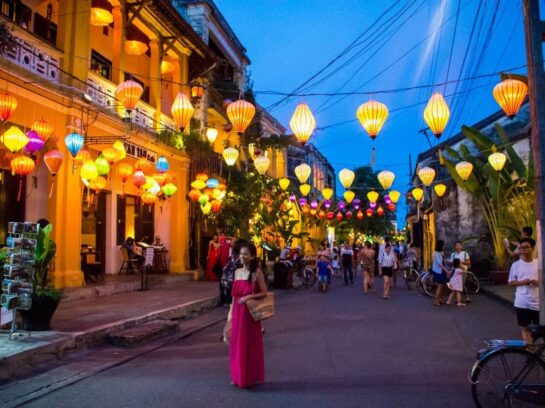
The center, around Hue and Hoi An, is the most complex and the spiciest. Hue was the imperial capital, and its food was developed to please emperors, so it is fussy, refined, and fiery. This is where you find bun bo Hue, a lemongrass-and-chili beef noodle soup that makes pho look gentle, and cao lau, a Hoi An noodle dish made with water from one specific well that locals insist cannot be replicated anywhere else.
The south, around Saigon, is sweeter, brighter, more abundant, closer to the Mekong's tropical bounty. Coconut creeps into everything. The herbs pile higher. The pho comes with a whole plate of basil, sawtooth herb, bean sprouts, and lime on the side, which the north considers vulgar and the south considers generous.
What to order, region by region
- Hanoi: pho bac, bun cha (grilled pork with noodles, the dish Obama ate here), egg coffee, a Hanoi invention where whipped egg yolk replaces milk.
- Hue: bun bo Hue, the fiery lemongrass beef soup, and the delicate imperial-style steamed rice cakes called banh beo.
- Hoi An: cao lau, white rose dumplings, and the banh mi that food writers have called the best sandwich in the world.
- Saigon: com tam, broken rice with grilled pork, hu tieu noodle soup, and the southern pho with its mountain of herbs.
- Everywhere: Vietnamese coffee, strong and dark, dripped through a metal filter over condensed milk, served hot or over ice.
The herbs are not garnish
When a plate of raw herbs arrives beside your soup, it is not decoration to be pushed aside. It is half the dish. Vietnamese eating is interactive: you tear the herbs in, squeeze the lime, add the chili, adjust the bowl to your own taste with each spoonful. Thai basil, mint, perilla, sawtooth coriander, each one changes the broth. Learning to build your own bowl is learning to eat Vietnamese.
Cheap food and serious technique are not opposites here. Vietnam proved you can do a 12-hour broth and sell it for the price of a bus ticket.
On the OJ Vietnam and Cambodia trip the food is not an afterthought, it is the spine of the route: the clean northern pho in Hanoi, the imperial complexity of Hue, the legendary banh mi of Hoi An, the herb-piled southern bowls of Saigon. You eat the country changing under you as you travel its length. That is the trip. The temples and the bay are the backdrop. The food is the story.
Frequently asked
Is Vietnamese food good for Indian vegetarians?
Excellent. Vietnam has a deep Buddhist vegetarian tradition, especially near pagodas. Fresh spring rolls, vegetable pho, tofu banh mi, and com chay, vegetarian rice plates, are all widely available. Look for the word chay, which means vegetarian. Confirm broths and fish sauce, as both contain animal products by default.
What is the difference between northern and southern pho?
Northern pho is clean and minimal, just clear broth, noodles, and beef, with confidence in the broth. Southern pho comes with a plate of herbs, bean sprouts, lime, and sauces to add yourself, and the broth is sweeter. Neither is wrong, they are two philosophies of the same dish.
How much does street food cost in Vietnam?
Pho costs 100 to 200 rupees, banh mi 60 to 100 rupees, Vietnamese coffee 50 to 100 rupees. Street food in Vietnam is among the best value in the world, and the street version is often better than the restaurant version.