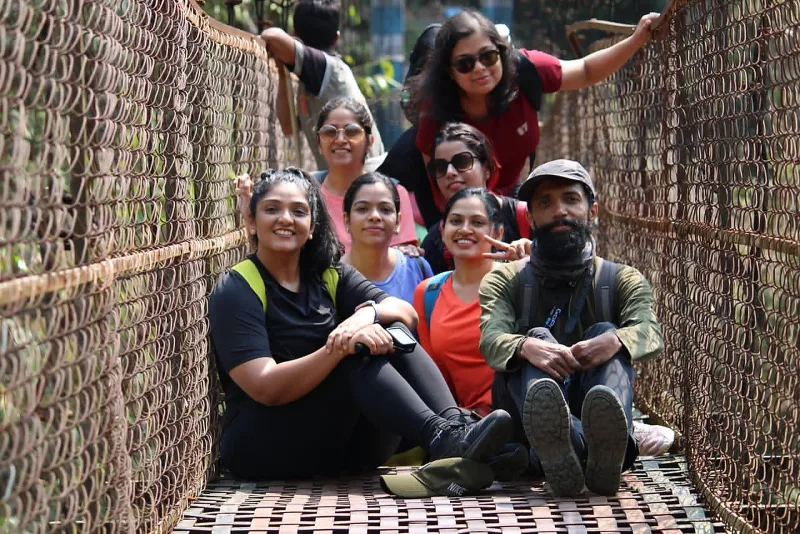
Most people who do Meghalaya do it wrong. They rush Shillong on day one, tick off Nohkalikai Falls on day two, snap the Dawki river from a bridge and call it done. If that is you, this meghalaya group trip itinerary will annoy you a bit, and then fix you.
Meghalaya is the wettest corner of India, home to the world's only living root bridges, a river so clear that boats appear to float on glass, and a city that has been called the rock capital of India for thirty years and means it. It also happens to be one of the few northeast states that requires zero permits for Indian travellers. No ILP, no paperwork, just a valid government ID and a bag packed for rain.
Here is a six-day itinerary built around actually experiencing the place, not ticking it.
Why Meghalaya Works Perfectly for a Group Trip
Meghalaya is custom-made for groups. The drives between Shillong, Cherrapunji and Dawki are scenic enough to be the activity, not just transit. The living root bridge trek is exactly the sort of thing that is more enjoyable when you are doing it with people you like. The Dawki boat ride is better when someone is calling out the fish you can see through twelve feet of water. And Shillong at night, with its live rock music scene, is the kind of place where a group dinner stretches past midnight without anyone noticing.
Logistics also improve with numbers. A private cab for the Cherrapunji circuit costs roughly Rs 2,500 to Rs 3,500 per day split across six people, which makes it cheaper than any shared transport. Homestays and guesthouses in the hills drop per-head significantly when you fill a room or take two rooms together. The economics of Meghalaya group travel are simply better.
How to Reach Meghalaya From Anywhere in India
The most convenient entry point is Guwahati, which has direct flights from Delhi, Mumbai, Bangalore, Hyderabad, Chennai and Kolkata. From Guwahati airport, Shillong is roughly 100 km, taking about two to three hours depending on traffic at Jorabat. Most group trips hire a tempo traveller or split into taxis from the airport, costing around Rs 2,500 to Rs 3,500 for the vehicle.
Shillong has its own small airport (SHL) but connectivity is limited. Guwahati is the reliable choice.
Flight costs from major cities (approximate, economy, advance booking):
| Origin City | Approximate One-Way Fare to Guwahati |
|---|---|
| Delhi | Rs 3,500 to Rs 6,500 |
| Mumbai | Rs 4,500 to Rs 8,000 |
| Bangalore | Rs 4,000 to Rs 7,500 |
| Hyderabad | Rs 3,800 to Rs 7,000 |
| Kolkata | Rs 2,000 to Rs 4,000 |
Always confirm fares at the time of booking. These shift constantly.
Alternatively, overnight trains from Kolkata to Guwahati are a budget-friendly option for groups who have the time. The journey is around 18 hours and costs Rs 800 to Rs 2,200 in sleeper or AC class.
Day 1: Arrive Guwahati, Drive to Shillong
Land in Guwahati, pick up the vehicle, and make the drive to Shillong. The road climbs through tea gardens and small Assamese towns before crossing into the hills. Stop at Umiam Lake (also called Barapani) on the way up. The lake is large enough to look like a sea from certain angles, and the light in the afternoon makes it worth ten minutes off the road.
Shillong itself is a proper hill town with a city inside it. Ward's Lake in the centre is worth a short evening walk, the Police Bazaar area has everything from local momos to coffee, and if your group has the energy, one of the live music venues near the MG Road area usually has something going by 8 PM.
Shillong calls itself the rock capital of India and that is not marketing. The city has produced serious bands for decades and the local live scene reflects it.
Accommodation: Guesthouses and hotels in Police Bazaar area from Rs 1,200 to Rs 2,500 per person per night in a shared room.
Day 2: Shillong Local Exploration
Keep day two for Shillong before heading deeper into the state. The city repays slow attention.
Elephant Falls is three km from the centre and has three distinct cascades. It is named after a rock that used to stand nearby before a 1897 earthquake removed it. The falls are best before 10 AM when crowds are thin.
Shillong Peak gives you a view of the entire valley and, on clear days, the Bangladesh plains in the distance. The road up is winding and the air is noticeably different from the city below.
In the afternoon, explore Bara Bazaar, the old market area where the Khasi community sells everything from smoked meat to beetle nut to woven shawls. Khasi cuisine is worth trying properly at least once. Jadoh (a rice and meat preparation), Dohneiiong (pork cooked in black sesame), and Tungtab (fermented fish) are all things you will not find anywhere else in India. There are small local restaurants around Police Bazaar that do these well for under Rs 200 a plate.
Day 3: Cherrapunji Circuit - Waterfalls and the Nohkalikai
This is the day most people remember longest.
Cherrapunji, now officially renamed Sohra, sits about 54 km from Shillong and holds the record for the highest rainfall in a single calendar month ever recorded on Earth. The drive there passes through viewpoints that open out over the Bangladesh plains on clear days. The scale of what you are looking at - flat green land stretching to the horizon, mist hanging over the valleys - is something photographs do not quite capture.
The Nohkalikai Falls drop 340 metres, making them the fourth tallest waterfall in the world. The plunge pool at the bottom is an unusual blue-green colour. The viewpoint is free, the falls are better in the post-monsoon months (October to December) when volume is highest, and the walk to the main viewpoint takes about fifteen minutes each way.
Seven Sisters Falls is a set of seven seasonal waterfalls that flow side by side during and after monsoon. In the October to January window, this is one of the most photographed spots in northeast India.
Mawsmai Caves are a short drive from the main Cherrapunji town. The limestone cave system takes about 30 minutes to walk through, parts of it narrow enough that you have to turn sideways.
Round trip from Shillong to the Cherrapunji circuit in a hired cab: Rs 2,500 to Rs 3,500. Entry fees across all sites add another Rs 100 to Rs 200 per person.
Day 4: Nongriat Trek to the Double Decker Living Root Bridge
Set the alarm early. This day earns its own paragraph.
The double decker living root bridge in the village of Nongriat near Cherrapunji is the thing Meghalaya is actually most famous for, even if most people cannot describe it precisely. The Khasi people have been guiding rubber fig tree roots across bamboo scaffolding for centuries, training them into living bridges that get stronger every year. The double decker bridge in Nongriat has two levels, one above the other, both functional, both old enough that the roots have fused into single thick cables.
Getting there requires a trek. From Tyrna village, the path descends about 3,500 stone steps into the valley. The round trip is 6 to 8 km and takes 4 to 6 hours depending on the group's pace. The steps are uneven in places and wet stone is genuinely slippery, so proper footwear is not optional. The descent is harder than it looks on a map. The ascent back up is harder than the descent.
The reward is worth it. There is a natural pool near the bridge where you can swim. The forest around Nongriat is dense, quiet and unlike anywhere in peninsular India.
Trek starting point logistics: Tyrna is about 9 km from Cherrapunji town. Cabs from Cherrapunji to Tyrna cost around Rs 300 to Rs 500. A small entry fee applies at the trailhead (confirm on arrival, currently around Rs 50 to Rs 100 per person).
Fitness note: This trek is not for people with bad knees or anyone who struggles with long downhill sections. On a group trip, it is worth discussing honestly before the day. If someone in the group wants to skip the trek, the Cherrapunji main viewpoints are a full day's activity on their own.
Day 5: Mawlynnong and Dawki
This is the most visually striking day of the trip and also the most relaxing.
Mawlynnong is 90 km from Shillong and holds a title it actually deserves: it was called Asia's cleanest village by Discover India magazine in 2003 and has maintained the standard since. Bamboo dustbins at every corner, no plastic anywhere, pathways swept daily. The village is Khasi-run and Khasi-proud. A tree house at the edge of the village gives a view over the Bangladesh border. Walk slowly, eat at one of the small local restaurants, and do not rush.
From Mawlynnong, Dawki is 28 km south. The Umngot river at Dawki is the kind of thing you have to see to believe. The water is so clear that boats appear to hover above the riverbed. On a bright morning, you can see fish moving through twelve feet of water. Boat rides on the Umngot cost around Rs 600 to Rs 800 per boat for 30 minutes, covering several people at once.
The Dawki bridge crosses into Bangladesh visually if not physically. The border check post is nearby and worth a walk.
Distance-wise, Mawlynnong and Dawki are usually combined in a single day trip from Shillong or done as a return from Cherrapunji. A private cab covering both runs Rs 3,000 to Rs 4,000.
Day 6: Departure - Shillong to Guwahati
Morning free for last-minute exploration in Shillong or rest. Drive to Guwahati airport for the flight out. Allow at least 3.5 to 4 hours from Shillong given the road and airport security timings.
If the flight is not until evening, there is time for a brief visit to Kamakhya Temple in Guwahati, one of the most important Shakti peethas in India.
What Does a Meghalaya Group Trip Cost in 2026?
Here is a realistic per-person INR breakdown for a group of 6 to 10 people over 6 days:
| Cost Component | Budget Per Person | Mid-Range Per Person |
|---|---|---|
| Flights (return, advance booking) | Rs 6,000 to Rs 10,000 | Rs 10,000 to Rs 18,000 |
| Accommodation (5 nights) | Rs 6,000 to Rs 10,000 | Rs 12,000 to Rs 20,000 |
| Transport (cabs, shared) | Rs 4,000 to Rs 6,000 | Rs 6,000 to Rs 9,000 |
| Food (all meals, 6 days) | Rs 3,000 to Rs 5,000 | Rs 5,000 to Rs 9,000 |
| Activities and entry fees | Rs 1,500 to Rs 3,000 | Rs 3,000 to Rs 5,000 |
| Total | Rs 20,500 to Rs 34,000 | Rs 36,000 to Rs 61,000 |
Group trip packages (including accommodation, transport within Meghalaya, and activities but excluding flights) typically run Rs 18,000 to Rs 35,000 per person for 5 to 6 nights. Confirm exact inclusions before comparing prices.
Do Indians Need Any Permit for Meghalaya?
No. Indian citizens can travel freely to all parts of Meghalaya without any Inner Line Permit or special documentation. Carry a valid government-issued ID, which is standard practice for domestic travel anyway.
This is one of the reasons Meghalaya is so accessible for a first-time northeast India trip. Other states in the region (Arunachal Pradesh, Manipur, Mizoram, Nagaland) require ILPs. Meghalaya does not. If you are planning Nagaland around the Hornbill Festival, that state does require an Inner Line Permit, which works differently.
Foreign nationals do not require an ILP either but must register with the Foreigners Registration Office in Shillong or at designated checkpoints.
Best Time to Go on a Meghalaya Group Trip
| Month | Conditions | Verdict |
|---|---|---|
| October to November | Post-monsoon, waterfalls full, clear skies | Best overall |
| December to February | Cool and dry, minimal crowds | Good for root bridge trek |
| March to April | Warm, cherry blossoms near Shillong | Good, rising crowds |
| May | Pre-monsoon, dry | Acceptable |
| June to September | Monsoon, extremely wet, trails slippery | For rain enthusiasts only |
October and November are the sweet spot. The waterfalls are at maximum volume from September rains, the skies clear up, and temperatures are comfortable across the day.
What to Pack for Meghalaya
Even outside monsoon, Meghalaya earns its name (it means "abode of clouds"). A light waterproof jacket and a small travel umbrella are worth carrying year-round. For the root bridge trek, shoes with grip are essential. Slippery stone steps in light sandals are a bad idea at any level of fitness.
Cash is important. ATMs exist in Shillong and Cherrapunji town but are scarce in Dawki and nonexistent in Mawlynnong and Nongriat. Carry enough for two to three days whenever heading away from Shillong.
Mobile connectivity: Jio and BSNL work reasonably well in Shillong. Coverage drops in the valleys around Nongriat. Download offline maps before leaving Cherrapunji.
Frequently Asked Questions
Is Meghalaya a good destination for a group trip from India?
How many days are enough for a Meghalaya trip?
Is the double decker living root bridge trek doable for average fitness?
What is the best way to travel between places in Meghalaya?
Is Meghalaya safe for group travel?
What food should we try in Meghalaya?
One in the Orange Jacket runs offbeat group adventures for travellers who have outgrown the usual circuit.
If Meghalaya sparks an appetite for northeast India, Bhutan backpacking is a logical next trip. For Central Asia on a bigger budget, OJ also runs the Pamir Highway and the cost breakdown is here.
Ready to do Meghalaya properly? Check out OJ's Meghalaya group trip and see the next batch dates.