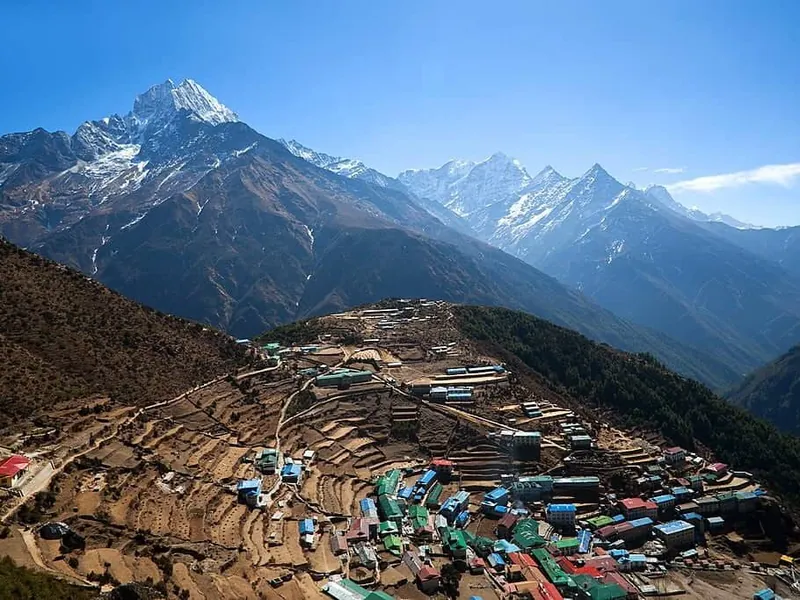
Destination Comparison
Everest Base Camp Trek vs Annapurna Base Camp Trek for Indians
Annapurna Base Camp wins on accessibility, lower altitude, shorter duration, and beginner-friendliness. Everest Base Camp wins on iconic status (standing at the foot of Everest), cultural depth (Sherpa villages, Tengboche Monastery), and the trek-of-a-lifetime feel. First Himalayan trek: ABC. Bucket-list trek: EBC.
Side by side
| Dimension | Everest Base Camp Trek | Annapurna Base Camp Trek | Winner |
|---|---|---|---|
| Total trip cost from India (10 to 14 days) | INR 1.1L to 1.5L | INR 60K to 1L | Annapurna Base Camp Trek |
| Visa difficulty | No visa needed for Indians | No visa needed for Indians | Tie |
| Flight time from India | 2 to 4 hours to Kathmandu | 2 to 4 hours to Kathmandu | Tie |
| Best months | October to November, March to April | October to November, March to April | Tie |
| Trek duration | 14 days total | 10 days total | Annapurna Base Camp Trek |
| Max altitude | 5,545m (Kala Patthar) | 4,130m (ABC) | Annapurna Base Camp Trek |
| Altitude sickness risk | Significant (up to 5,545m) | Moderate (AMS is common at 4,130m) | Annapurna Base Camp Trek |
| Physical demand | Strong fitness required | Moderate fitness sufficient | Annapurna Base Camp Trek |
| Prior trek experience needed | Strongly recommended | Helpful but not required | Annapurna Base Camp Trek |
| Iconic status (story value) | Trek of a lifetime | Strong but less iconic | Everest Base Camp Trek |
| Cultural depth | Deep (Sherpa villages, Tengboche Monastery) | Good (Gurung villages, Poon Hill) | Everest Base Camp Trek |
| Crowd levels (peak season) | Heavy (most popular trek globally) | Moderate (less crowded than EBC) | Annapurna Base Camp Trek |
Choose Everest Base Camp Trek if
- Standing at Everest Base Camp is a non-negotiable bucket-list item
- You have done one moderate Himalayan trek before (ABC, Hampta, Sandakphu)
- You have strong cardio fitness and can train 4 months pre-trek
- You can absorb 14 days plus 2 buffer days for Lukla flights
- Sherpa cultural experience and Tengboche Monastery appeals
Choose Annapurna Base Camp Trek if
- This is your first Himalayan trek
- You have moderate fitness baseline
- Budget matters (ABC is 30 percent cheaper)
- 10 days is your maximum trek commitment
- You want a high-altitude experience without the EBC altitude risk
Frequently asked
EBC or ABC for first Himalayan trek from India?
ABC, by a wide margin. EBC requires prior moderate-altitude trek experience because of the 5,545m max altitude. ABC at 4,130m is lower, though altitude sickness can still start above about 2,500m, and it is the natural first Himalayan trek. Most experienced Himalayan trekkers did ABC first, EBC second.
Is the altitude difference between EBC and ABC really that significant?
Yes. EBC reaches 5,545 metres at Kala Patthar viewpoint. ABC tops out at 4,130 metres. Altitude sickness can start above about 2,500 metres, so both carry real risk, and it rises with height. The difference is real: most ABC trekkers feel mild altitude effects, most EBC trekkers feel moderate to severe altitude effects. Acclimatization profile matters.
Which is more crowded, EBC or ABC?
EBC by 4 to 5 times. Nepal sees roughly 35,000 EBC trekkers per year vs 8,000 plus on ABC. Peak season EBC trails feel like queues at popular tea houses. ABC is also touristed but feels significantly more spacious.
What is the worst-case difficulty in each trek?
EBC worst case: severe altitude sickness at Lobuche or Gorak Shep (5,000m plus) requiring helicopter evacuation. We have evacuated 3 trekkers in 5 years on EBC. ABC worst case: moderate altitude sickness at ABC requiring descent to Bamboo (about 2,310m). We have evacuated 1 trekker in 4 years on ABC. EBC carries materially higher risk.
Does OJ run both treks?
Yes. OJ Annapurna Base Camp runs 15 to 21 Nov (6 days, from Rs 45,000). OJ Everest Base Camp runs 12 nights, from USD 1,600 to 1,700. Different audiences: ABC for first-time Himalayan trekkers, EBC for experienced trekkers ready for the bucket-list summit.