Most travel blogs give you a range so wide it's useless. "Rs 30,000 to Rs 1.5 lakh" tells you nothing. The bhutan trip cost from India is genuinely reasonable for Indians - because of a pricing system that gives us a massive structural advantage over every other nationality. This post breaks down every rupee: what you actually pay, where you can trim, and what costs are fixed regardless of how clever you are.
Why Indians Get a Deal That No Other Nationality Gets
Bhutan runs a "High Value, Low Impact" tourism model. For most nationalities that means paying $100 per person per night as a Sustainable Development Fee (SDF) - that's roughly Rs 8,300 per night, before accommodation, food, or anything else.
Indians are in a completely different bracket. As of 2026, the SDF for Indian passport holders is Rs 1,200 per person per night. That is it. No visa fee on top. No minimum spend requirement. The Bhutanese Ngultrum is also pegged 1:1 with the Indian Rupee, so there is no currency conversion math to deal with.
On a 6-night trip, the SDF cost for an Indian is Rs 7,200. A British traveller pays the equivalent of nearly Rs 50,000 for the same six nights in SDF alone, before spending a single rupee on a hotel room. This rate is confirmed until 31 August 2027, so it is not changing anytime soon.
Entry permit: free. Voter ID or a valid Indian passport is sufficient. You do not need to visit a consulate or apply weeks in advance.
How to Reach Bhutan From India: Cost Comparison
You have two ways in: fly into Paro, or cross the border by road at Phuentsholing.
By Flight
Paro airport is one of the most dramatic landing strips in the world, hemmed in by the Himalayan valley. Only Drukair (Royal Bhutan Airlines) and Bhutan Airlines operate services, which keeps fares higher than a typical budget route.
- Delhi to Paro: Rs 22,000 to Rs 30,000 return
- Kolkata to Paro: Rs 16,000 to Rs 22,000 return (shortest flight, around 90 minutes)
- Mumbai to Paro: Rs 28,000 to Rs 38,000 return (fewer direct options, sometimes via Kolkata)
Book 6 to 8 weeks ahead for the lower end of these ranges. Last-minute Paro fares are brutal.
By Road to Phuentsholing (Then Transfer)
This is how budget travellers and most group trips do it. You travel to Bagdogra (fly or train) or Siliguri, take a shared taxi or bus to the Phuentsholing border, cross on foot, get your entry permit at the immigration office on the Bhutan side, and then take a cab or shared bus up to Thimphu (about 5 to 6 hours, Rs 250 to Rs 350 per person on a shared basis).
The road approach saves money on the entry leg but adds a day. Many OJ-style groups treat the Phuentsholing crossing itself as part of the adventure.
| Entry Method | Approx. Cost From Delhi | Time to Thimphu |
|---|---|---|
| Flight (Delhi-Paro) | Rs 22,000-30,000 return | 3-4 hours total |
| Train to NJP + road | Rs 4,000-7,000 total | 18-24 hours |
| Flight to Bagdogra + road | Rs 8,000-14,000 total | 8-10 hours |
Accommodation Costs in Bhutan: What Rs 1,500 to Rs 10,000 Gets You
Bhutan has options across every band, though true "backpacker hostels" are rare.
- Budget guesthouses: Rs 1,200 to Rs 2,500 per room per night. Typically a family-run property with clean rooms, local breakfast, and excellent helpings of ema datshi (the national dish, a cheese and chilli stew that will ruin you for all other food).
- Mid-range hotels (3-star equivalent): Rs 4,000 to Rs 7,000 per room. Good hot water, more reliable heating, sometimes a view of the valley.
- Boutique and heritage properties: Rs 8,000 to Rs 15,000. Some Bhutanese farmhouse conversions at this level are genuinely stunning.
- Luxury resorts (Amankora, Six Senses, etc.): Rs 40,000 to Rs 1,00,000+ per room. A different trip entirely.
Group travel cuts accommodation costs substantially because transport in Bhutan is charged per vehicle. A group of 8 filling a van pays the same taxi rate as a group of 2 - the per-person cost drops sharply. The same logic applies to splitting rooms.
Food Budget in Bhutan: Eating Well for Rs 400 to Rs 800 a Day
Bhutanese food is distinctive and worth eating beyond the first meal. Red rice, ema datshi (chilli and cheese), phaksha paa (pork with red chillies), and suja (butter tea, which is an acquired taste) make up the staples.
A full meal at a local restaurant costs Rs 150 to Rs 350. Slightly more touristy but still genuine places run Rs 400 to Rs 600 for a proper spread.
Indian restaurants exist in Thimphu if anyone in the group has hit their chilli limit. Cafes and bakeries have multiplied in Thimphu and Paro in recent years - a good flat white and a croissant near the Paro clock tower costs less than it would in Bengaluru.
Budget Rs 500 to Rs 700 per day for food if you are eating at local spots. Factor in Rs 800 to Rs 1,000 if you want the occasional sit-down tourist restaurant and a few drinks.
Transport Within Bhutan: The Non-Negotiable Fixed Cost
Internal transport is the cost that surprises people. You are not in a country with Ola, Rapido, or even reliable public buses beyond a few routes.
Getting between cities (Thimphu, Punakha, Paro, Phobjikha) requires renting a vehicle with a driver. Rates are charged per day or per leg.
- Thimphu to Punakha (2.5 hours): Rs 2,500 to Rs 4,000 for a vehicle
- Thimphu to Paro (1 hour): Rs 1,500 to Rs 2,500 for a vehicle
- Full-day sightseeing within a valley: Rs 2,000 to Rs 3,500
Again, the group travel logic applies hard here. Divided among 6 or 8 people, a Rs 3,000 vehicle leg costs Rs 375 to Rs 500 per person. Solo, you absorb the whole Rs 3,000.
Permits: What You Need Beyond the Entry Permit
The basic entry permit (free for Indians) covers Thimphu and Paro. If you want to visit Punakha, Bumthang, Haa Valley, Phobjikha, or any other district, you need a route permit from the immigration office in Thimphu.
Route permits are inexpensive (under Rs 500 per person) and straightforward to get on a working day at the Thimphu immigration office. The process takes an hour at most. Your hotel or tour operator can usually handle the paperwork if you are going through one.
Budget roughly Rs 300 to Rs 500 per district for the route permit. This is not a hidden cost - it is just rarely mentioned in the glossy package listings.
The Full Budget Table: What a 7-Night Bhutan Trip Costs
This is a realistic breakdown for an Indian travelling on a group trip in 2026, covering Thimphu, Punakha, Phobjikha, and Paro.
| Cost Category | Budget (per person) | Mid-Range (per person) |
|---|---|---|
| Flights (Kolkata return) | Rs 16,000 | Rs 22,000 |
| SDF - 7 nights at Rs 1,200 | Rs 8,400 | Rs 8,400 |
| Accommodation - 7 nights shared | Rs 5,600 | Rs 12,600 |
| Food - 7 days | Rs 3,500 | Rs 6,300 |
| Internal transport (shared group) | Rs 3,500 | Rs 5,500 |
| Entry permit + route permits | Rs 0-500 | Rs 0-500 |
| Entry fees, tips, misc | Rs 1,500 | Rs 3,000 |
| Total | Rs 38,000-42,000 | Rs 58,000-65,000 |
Flying from Delhi adds Rs 6,000 to Rs 10,000 to the flight column. Going solo (no group to split vehicles and rooms with) adds Rs 5,000 to Rs 10,000 across accommodation and transport.
What Can You Actually Cut (And What You Cannot)
Cannot cut: The SDF. Every night you stay costs Rs 1,200 per person. Trying to day-trip in and out to avoid it is logistically impractical and misses the point of going.
Can cut: Flights. The Kolkata to Paro route is consistently cheaper than Delhi. If you are not based in the northeast, a train to New Jalpaiguri (NJP) followed by a road crossing at Phuentsholing is the single biggest lever you can pull on cost - it can save Rs 12,000 to Rs 18,000 compared to a direct Delhi flight.
Can cut: Accommodation, but only if you travel in a group. Two people sharing a budget room is Rs 750 per person per night. Four people moving through smaller properties can sometimes negotiate even better rates.
Cannot meaningfully cut: Internal transport. Bhutan's road network requires vehicles. The per-person cost depends entirely on how many people you are sharing with.
When to Go: Cost and Weather
The two peak seasons - spring (March to May) and autumn (September to November) - have the best weather and the best visibility of the Himalayan peaks. They are also when flights and hotels are more expensive and more booked.
Festival season is an exception worth knowing about. The Paro Tshechu (March-April) and Thimphu Tshechu (September-October) draw domestic and international visitors. If you are going specifically for a festival, book 3 to 4 months ahead.
Winter (December to February) is cold at altitude but dramatically quieter and cheaper. Hotel rates drop 20 to 30 percent. The apple orchards are bare but the skies are crystal clear and you practically have Tiger's Nest to yourself on a weekday. If you plan your international trip around off-peak timing, Bhutan in December or January is one of the smartest calls you can make.
Monsoon (June to August) is wet, leechy in the forests, and cheaper still. Not recommended as a first visit but fine if you specifically want lush green valleys and no crowds.
Group Trip vs. Solo vs. Package Tour: Which Makes Financial Sense
Solo: The most expensive way to do Bhutan. You absorb the full cost of vehicles, often pay a single-occupancy supplement at hotels, and lose any negotiating scale. Budget at least Rs 55,000 to Rs 70,000 for 7 nights.
Standard package tour: The most common approach. Operators in India bundle flights, accommodation, SDF, transport, and a guide into a single price. Packages typically run Rs 45,000 to Rs 80,000 per person for 5 to 7 nights depending on hotel tier. The number sounds reasonable but the itinerary is usually rigidly tourist-circuit: Thimphu clock tower, Punakha Dzong, Tiger's Nest, repeat. You rarely get the backroads, the local restaurants, or spontaneous detours.
Group adventure trip: The sweet spot for the reader who has outgrown the usual circuit. A group of 10 to 16 people who actually want to be there - not a bus tour - gets group vehicle rates, honest hotel picks, and leaders who know which roads to take after Dochula Pass. Per-person costs land in the Rs 38,000 to Rs 55,000 range for a proper 7-night itinerary including SDF.
If you want to compare this trip against Nepal, the Bhutan vs Nepal comparison breaks down exactly which Himalayan country makes more sense for your first adventure, and why many people eventually do both.
The Tiger's Nest Hike: What It Actually Costs and Takes
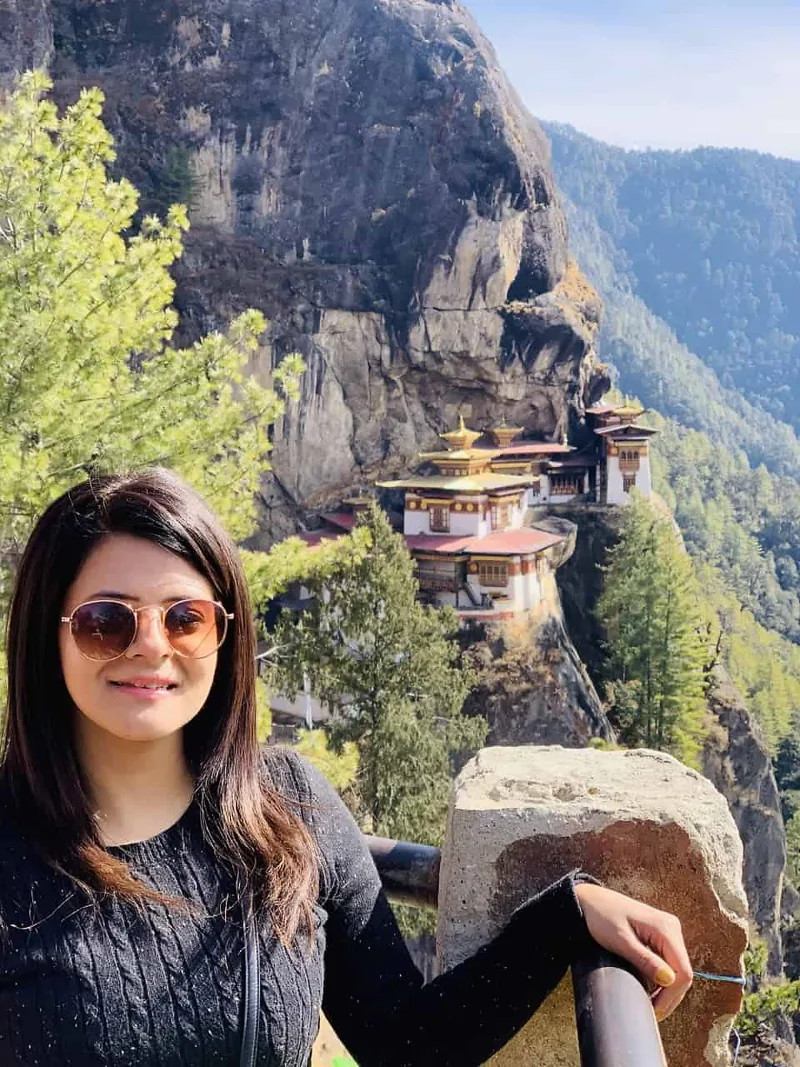
No Bhutan trip budget is complete without accounting for Taktsang, the Tiger's Nest Monastery. It sits on a cliff 900 metres above the Paro valley floor and is the defining image of Bhutan.
The hike is 4 to 5 hours return (roughly 9 km) on a well-maintained trail. There is a horse option for the first section if someone in the group needs it (Rs 1,200 to Rs 1,500 one way).
Entry to the monastery complex: Rs 500 per person. A cafeteria at the halfway viewpoint sells drinks and snacks at normal Bhutanese prices.
No special permit required. Wear layers - the cliff gets cold even in April. Start early (7 am) to reach the monastery by 9 to 10 am before the day-trippers arrive.
Frequently Asked Questions
How much money do I need for a 7-day Bhutan trip from India?
Do Indians need a visa for Bhutan?
What is the SDF and how much do Indians pay?
Is Bhutan expensive for Indian travellers?
Can I travel Bhutan without a tour operator?
What is the best route to Bhutan from India without flying?
One in the Orange Jacket runs offbeat group adventures for travellers who have outgrown the usual circuit. If Bhutan sounds like your kind of trip, see the OJ Bhutan group trip and check upcoming dates.