If you have been sitting on the fence about Bhutan vs Nepal for Indians, you are not alone. These two countries are neighbours, both Himalayan, both Buddhist, both visa-free for Indian passport holders, and both likely to ruin every holiday you take afterwards. The problem is they are almost nothing alike once you actually get there. One is a controlled, intentionally slow, culturally immersive country that actively limits how many people walk through it. The other is a chaotic, democratic, trekker-saturated paradise where you can show up with a backpack and figure it out as you go. Choosing the wrong one for the wrong trip is a very avoidable mistake. Here is what the choice actually looks like from an Indian perspective in 2026.
Are They Really That Different?
Short answer: yes. Nepal is the adventure capital of the Himalayas. It has the Everest Base Camp trail, the Annapurna Circuit, paragliding in Pokhara, bungee jumping over the Bhote Koshi, and a nightlife scene in Thamel that keeps going until well past midnight. It is also loud, crowded in peak season, and moves at a pace that has little patience for lingering. Bhutan is the opposite. It has no traffic lights in most towns, no McDonald's, no mass-market package tours, and a government that has kept visitor numbers deliberately low for decades. You cannot enter Bhutan without booking through a registered agency and paying a daily fee. That is not a bug, it is the entire point. The experience you buy is one of relative quiet, intact culture, and monastery hikes where you do not share the trail with 800 other people.
The Cost Question: How Much Does Each Trip Cost Indians?
This is where things get concrete. Nepal is straightforwardly cheaper.
| Item | Nepal (INR estimate) | Bhutan (INR estimate) |
|---|---|---|
| Flight from Delhi (return) | 8,000 to 18,000 | 14,000 to 28,000 (Paro) |
| Road entry option | Yes, Gorakhpur to Pokhara, Raxaul to Kathmandu | Yes, Phuentsholing border crossing |
| Daily accommodation (budget) | 700 to 2,000 | 2,500 to 5,000 |
| Daily food | 500 to 1,500 | 1,000 to 2,500 (most packages include meals) |
| Sustainable Development Fee | None | INR 1,200 per person per night |
| Trekking permit (ACAP, SAARC rate) | NPR 1,000 (approx. INR 620) | Included in guide package |
| Visa fee | Nil | Nil |
| Typical 7-day trip total | INR 30,000 to 55,000 | INR 55,000 to 1,00,000+ |
A few things worth noting. The INR 1,200 per night SDF (Sustainable Development Fee) for Indians is confirmed through 31 August 2027. That is actually a significant discount from the USD 100 per night that other nationalities pay. On a 5-night Bhutan trip, that is INR 6,000 in SDF alone, but your package usually includes a licensed guide, certified accommodation, and local transport, so the sticker shock is partly offset by what it covers. Nepal, on the other hand, lets you go fully DIY or book packages. The SAARC discount on trekking permits is genuine: Indians pay NPR 1,000 (roughly INR 620) for the Annapurna Conservation Area Permit instead of NPR 3,000 for foreigners.
For a detailed breakdown of what Bhutan costs at different budget levels, the Bhutan trip cost from India guide covers the full INR math.
What Can You Actually Do: Experiences Side by Side
Nepal is primarily about physical adventure. The Annapurna Base Camp trek is 7 to 10 days, moderately strenuous, and reaches 4,130 metres. Everest Base Camp is a 14-day slog to 5,364 metres and requires proper acclimatisation. Both are stunning. If trekking is your main draw, Nepal has no rival anywhere on earth for variety, range of difficulty, altitude options, and quality of established teahouse infrastructure. Outside trekking: Pashupatinath temple in Kathmandu, the medieval streets of Bhaktapur, sunrise from Nagarkot, rafting on the Trishuli.
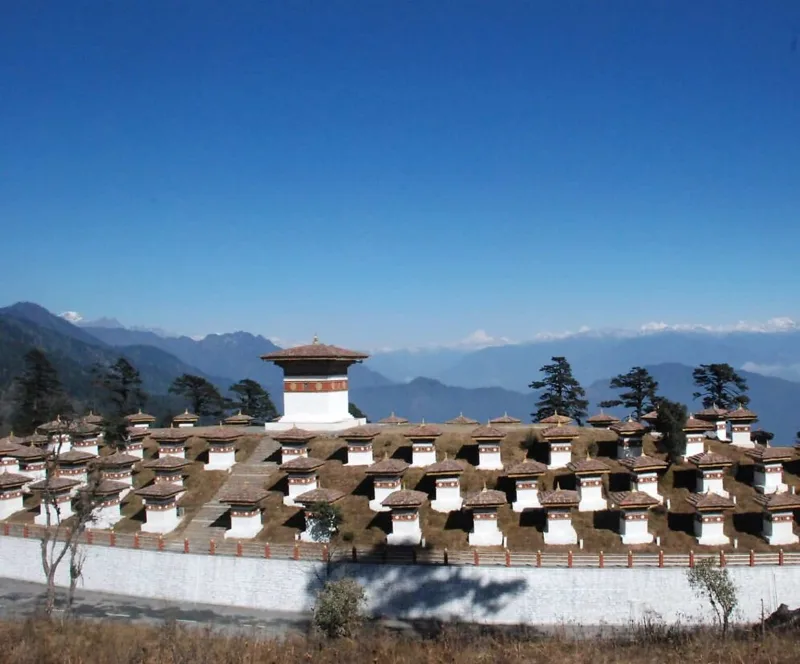
Bhutan is primarily about culture and landscape. The Tiger's Nest Monastery (Paro Taktsang) is the unmissable hike, a 4.5 km trail to a 17th-century monastery perched 900 metres above the Paro Valley floor. It takes about two to three hours up, is closed on Tuesdays, and requires covered shoulders and knees inside. Beyond Tiger's Nest: Dochula Pass with its 108 chortens and panoramic Himalayan view on clear days, the Punakha Dzong at the confluence of two rivers, the black-necked crane valley at Phobjikha, and the Thimphu weekend market. If a festival is timed right, the Tshechu dances in Paro or Thimphu are something no packaged tour in Asia can replicate.
The honest verdict: Nepal wins on adventure volume. Bhutan wins on depth of experience.
Permits and Entry: What Indians Actually Need
Nepal: No visa, no fee. Enter with your Indian passport or a valid government photo ID (Voter ID, Aadhaar with photo, driving license). Carry two passport-size photos if entering by land. Trekking permits are bought in Kathmandu at the Nepal Tourism Board office or at the trailhead, but it costs more at the trailhead.
Bhutan: No visa, but you do need an entry permit, issued at Phuentsholing (land) or Paro Airport (air). Valid documents are a passport or Voter ID card. Aadhaar and PAN cards alone are not accepted. Carry two passport-size photos. The permit is valid for 15 days. Budget for INR 1,200 per night SDF. Most tour operators handle the paperwork if you book through them.
The permit complexity is genuinely higher in Bhutan. It is manageable, but if you show up at the Phuentsholing border without having done any reading, you will lose time. Bhutan also requires you to stay in approved accommodation throughout. Independent free-camping is not permitted.
Trekking: Which Country Is Better for Which Kind of Trekker?
If you want to tick a serious altitude achievement, Nepal. EBC at 5,364 metres is something Bhutan simply cannot match in terms of raw altitude. Bhutan's highest-altitude trek, the Snowman Trek (across several passes above 5,000 metres), is one of the hardest in the world, but it is a two-to-three week expedition that almost nobody completes.
If you want to trek somewhere that still feels like you discovered it, Bhutan. Even Tiger's Nest, the most visited attraction in the country, has a fraction of the footprint of the Annapurna trail in peak season.
If you are a first-time trekker with moderate fitness, both countries have accessible options. Annapurna Base Camp and Tiger's Nest are both doable for people who walk regularly but have never trekked before. Tiger's Nest is tougher than it looks on photos.
The Everest Base Camp trek guide for Indians is worth reading before you commit to EBC, especially the permit section.
Culture and Crowd Control: Bhutan's Real Advantage
This is the thing that rarely gets said plainly in travel content: Nepal is overrun in peak season. The Annapurna and Everest trails in October see thousands of trekkers a day. Kathmandu's heritage sites are crowded, loud, and surrounded by souvenir stalls. None of that makes Nepal any less incredible, but it is worth knowing.
Bhutan has 300,000 visitors a year to Nepal's 1.5 million, roughly. That ratio shows up in the experience. Monasteries without bus groups. Towns without tourist lanes. Trails where you mostly hear the wind. The SDF is essentially paying for a country that has deliberately not been overrun. Whether that is worth INR 1,200 per night is a genuine question only you can answer, but the trade-off is real.
Bhutan also scores on cultural integrity. The Dzong architecture is alive, not just preserved for tourists. Locals wear the Gho and Kira, the national dress, as daily clothing. The Tshechu festivals are religious ceremonies that happen to be open for visitors, not performance events staged for cameras. It is a different category of cultural experience from anything you find in the region.
Getting There From India: Flights and Road Entry Compared
Nepal by air: Kathmandu (KTM) is well-connected from Delhi, Mumbai, Kolkata, Chennai, Bengaluru. Budget carriers including IndiGo and Air India fly the route. Return fares from Delhi start around INR 8,000 in off-season and climb to INR 15,000 to 18,000 in October. Pokhara now has an international airport with limited India connectivity.
Nepal by road: Completely viable and popular from eastern India. Gorakhpur to Pokhara (via Sunauli border) is a classic route. Patna or Raxaul to Kathmandu is another. Bus travel is cheap and genuinely adventurous.
Bhutan by air: Paro Airport (PBH) is served by Druk Air and Bhutan Airlines from Delhi, Kolkata, Mumbai, Bangalore, and Guwahati. Flights start around INR 14,000 return and go up to INR 25,000 in peak season. Paro Airport is one of the most scenic approaches in the world and genuinely worth the window seat.
Bhutan by road: Enter via Phuentsholing (from Siliguri, West Bengal, which is easy to reach by train from Kolkata or a flight to Bagdogra). The road entry is slower but significantly cheaper and gives you a day in the border town before permits are processed. Jaigaon is the last Indian town before the gate, and the contrast as you walk across is sharp.
For Indians in the northeast, Bhutan by road is the easiest international trip you will ever take. Under INR 5,000 gets you to the border from Guwahati. That changes the cost calculation entirely.
The Honest Answer: Which One to Visit First?
It depends on what you are chasing.
Visit Nepal first if: you want a proper multi-day trek, you are on a tight budget, you are going with a mix of fitness levels who want flexibility, or you have always wanted to stand at the foot of the highest mountain on earth.
Visit Bhutan first if: you want a complete culture immersion without crowds, you are going as a couple or a small group and want a curated, guided experience, or you are in eastern India and want a genuinely different country experience over a long weekend.
The best possible outcome is to do both. They are two to three hours apart by flight and less than a day apart by road through the northeast corridor. Several OJ groups have done Bhutan as a four-day add-on before or after a Nepal week. It is very doable.
If you are doing one right now, and you have never left India, start with Nepal. It is more forgiving logistically, cheaper to course-correct if something does not land, and the trekking infrastructure means you can push yourself as hard or as gently as you want. Come back to Bhutan when you want slow, quiet, and intentional.
For anyone who has been to Southeast Asia a few times and wants something that does not feel like a repeat, start with Bhutan. It is unlike anything you have done.
A Note on Group Trips for Both Destinations
Solo or self-planned travel works fine in Nepal. It is a bit harder in Bhutan because of the mandatory guide requirement, which is why most Indian travellers book through an operator. A group trip solves both the planning effort and the guide cost, since the guide cost is split across the group rather than sitting entirely on you. It also means the permit logistics, accommodation bookings, and SDF payments are handled before you land.
OJ runs group trips to both. For Bhutan, check the Bhutan group trip page for current batch dates, pricing and what is included. For Nepal treks, the Everest Base Camp guide has the permit and fitness detail you need before committing.
Frequently Asked Questions
Is Bhutan more expensive than Nepal for Indians?
Do Indians need a visa for Bhutan or Nepal?
Which country has better trekking for Indians?
Can Indians enter Bhutan by road?
What is the best time to visit both countries?
Which country is better for a first international trip?
One in the Orange Jacket runs offbeat group adventures for travellers who have outgrown the usual circuit.