The Everest Base Camp trek for Indians is cheaper, faster to organise, and more forgiving on paperwork than most people think. No visa, discounted SAARC permits, and direct flights from Delhi, Mumbai, or Kolkata to Kathmandu make this the most accessible bucket-list trek on the planet for an Indian passport holder. The hard part is not the logistics. The hard part is 130 kilometres of Himalayan trail, two weeks of teahouse food, and an altitude that strips roughly half the oxygen from every breath you take above 5,000 metres.
This guide covers everything you actually need: what you will spend, how to get there, what the permits cost as an Indian national, how difficult the trek really is, and what no one tells you before you go.
No Visa, No Forms: The India-Nepal Entry Advantage
Indians enter Nepal without a visa. Under the 1950 Indo-Nepal Treaty of Peace and Friendship, Indian passport holders enjoy completely free movement between the two countries, with no visa fees, no stickers, and no pre-approval required. You can enter on your Indian passport or even a valid Voter ID card with photo.
This matters because for non-Indian trekkers, a Nepal tourist visa costs USD 30 for 15 days or USD 50 for 30 days, applied for on arrival at Tribhuvan Airport or online. You skip all of that. Your savings start before you even land.
One practical note: if you plan to fly out of Kathmandu to a third country after the trek, you will need a No Objection Certificate from the Indian Embassy in Kathmandu. This does not affect the Nepal entry itself; it is an Indian government requirement for onward travel.
SAARC Permit Rates: What Indians Actually Pay
Every EBC trekker needs two permits. As an Indian national (SAARC), you pay a fraction of what citizens of other countries pay.
| Permit | Indian / SAARC Rate | Foreign Rate |
|---|---|---|
| Sagarmatha National Park Entry | NPR 1,500 (~INR 940) | NPR 3,000 |
| Khumbu Rural Municipality Permit | NPR 2,000 (~INR 1,250) | NPR 2,000 |
| TIMS Card (Trekkers' Information Management System) | NPR 1,000 (~INR 625) | NPR 2,000 |
| Total Permits | ~INR 2,800 | ~INR 5,600 |
You obtain all three in Kathmandu before your flight to Lukla. Your trekking agency or a hotel will help with the paperwork. It takes one morning. Always confirm the current rates at the official Nepal Tourism Board (ntb.gov.np) before you travel, as fees are reviewed periodically.
Real Cost Breakdown From India
This is the number everyone searches for, and the number most blogs get wrong because they quote Nepal-only figures in USD. Here is what Indians actually spend, in INR, for the full trip from an Indian city to EBC and back.
| Category | Budget Option | Mid-Range |
|---|---|---|
| Return flight (India to Kathmandu) | INR 7,000-12,000 | INR 15,000-25,000 |
| Kathmandu to Lukla return (mountain flight) | INR 11,000-14,000 | INR 14,000-18,000 |
| Permits (all three) | ~INR 2,800 | ~INR 2,800 |
| Guide + Porter (14 days) | INR 25,000-35,000 | INR 40,000-60,000 |
| Teahouse accommodation (13 nights) | INR 12,000-18,000 | INR 25,000-40,000 |
| Food on trail (14 days) | INR 18,000-25,000 | INR 30,000-45,000 |
| Kathmandu hotel (2 nights) | INR 3,000-5,000 | INR 7,000-15,000 |
| Gear, tips, incidentals | INR 8,000-15,000 | INR 15,000-25,000 |
| Total | ~INR 86,000-1,07,000 | ~INR 1,48,000-2,30,000 |
A few honest caveats. The Kathmandu-Lukla mountain flight is seasonal. During peak spring season (mid-March to mid-May 2026) and peak autumn (late September to late November 2026), flights frequently depart from Ramechhap Airport instead of Kathmandu, roughly four hours by road from the city. Budget an extra night and INR 2,000-3,000 for the road transfer. Flight cancellations due to weather are common; build at least two buffer days into your schedule.
Group packages through Indian operators typically price in the INR 1,30,000-1,80,000 range all-in, which includes Kathmandu accommodation, airport transfers, permits, guide, porter, teahouse meals, and local transport. Booking direct through a Nepali agency saves 15-20%, though you manage more logistics yourself.
The Lukla Flight: The Part No One Mentions
Most trekkers worry about altitude. Experienced trekkers also worry about Lukla. Tenzing-Hillary Airport at 2,860 metres has a 527-metre uphill runway ending at a steep cliff. Flights operate on clear weather only and are frequently cancelled at short notice. This is not a scare story; it is a logistical reality you plan around.
Book Lukla flights (and your entire trip) with a SAARC-licensed Nepali carrier such as Tara Air or Summit Air. One-way costs around INR 11,000-14,000 for Indian nationals. If weather cancels your return flight, the standard alternatives are a 5-6 day trek back to Salleri and a road journey, or a helicopter charter (USD 500-700 per person shared). Travel insurance that covers flight cancellation and helicopter evacuation is not optional on this trek.
From India, the most common entry points are Delhi (DEL-KTM from INR 7,000), Mumbai (BOM-KTM from INR 8,500), and Kolkata (CCU-KTM from INR 10,000-15,000). IndiGo, Air India, and Nepal Airlines all operate this route. Kolkata is geographically closest to Kathmandu but often has fewer direct flights and higher fares.
The Standard 14-Day Itinerary
This is the route that works. Shorter versions (10-12 days) cut acclimatisation, which raises your risk of altitude sickness significantly. Do not do them.
- Day 1: Fly to Kathmandu, arrive, rest
- Day 2: Kathmandu to Lukla by mountain flight, trek to Phakding (2,610 m)
- Day 3: Phakding to Namche Bazaar (3,440 m)
- Day 4: Acclimatisation day in Namche - hike to 3,880 m, sleep at 3,440 m
- Day 5: Namche to Tengboche (3,860 m), visit the famous monastery
- Day 6: Tengboche to Dingboche (4,410 m)
- Day 7: Acclimatisation day in Dingboche - hike to 4,800 m, sleep at 4,410 m
- Day 8: Dingboche to Lobuche (4,940 m)
- Day 9: Lobuche to Gorak Shep (5,164 m), then to Everest Base Camp (5,364 m), back to Gorak Shep
- Day 10: Early morning Kala Patthar summit (5,545 m) for the classic Everest view, descend to Pheriche (4,240 m)
- Day 11: Pheriche to Namche (3,440 m)
- Day 12: Namche to Lukla (2,860 m)
- Day 13: Fly Lukla to Kathmandu, rest and explore
- Day 14: Depart Kathmandu
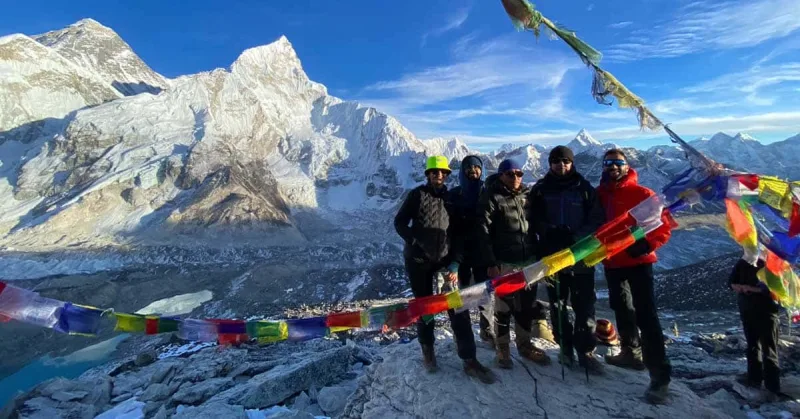
Kala Patthar, not EBC itself, gives you the iconic Everest sunrise photograph. Base Camp is actually a boulder field of tents and glacier ice most of the year; the real vista is from Kala Patthar. Do not skip it.
How Hard Is It, Honestly?
The EBC trek is classified as strenuous. It is not a technical climb. There are no ropes, no ice axes, no vertical faces. You walk. You walk uphill, on rocky trails, for 5-7 hours a day, at altitudes where a fast pace leaves you gasping.
The physical demands are real: 130 kilometres round trip, 12-14 days of consecutive trekking, and a maximum altitude of 5,545 metres at Kala Patthar. If you regularly run, cycle, or hike at home, you have the baseline fitness. If you do not exercise at all, you will struggle, and you will also risk altitude sickness more.
The bigger variable is how your body responds to altitude. Fitness does not protect against altitude sickness. Around 25-50% of EBC trekkers experience Acute Mountain Sickness (AMS) in some form, typically headaches, nausea, and fatigue above 3,500 metres. The solution is not to push through it. The solution is to acclimatise properly, follow the golden rule of high-altitude trekking ("climb high, sleep low"), and descend immediately if symptoms worsen.
Recommended training for Indians with a desk job: 3-4 months before the trek, start with 5-kilometre walks and build to 15-kilometre weekend hikes with a loaded pack. Add staircase climbing if you live in a flat city.
If you want a softer introduction to high-altitude Nepal before attempting EBC, the Annapurna Base Camp trek is a shorter route that tops out at 4,130 metres, no acclimatisation days required.
Best Time to Trek From India
October and November are the peak months. Clear skies, stable temperatures, sharp mountain views. Trails are busy. Book Lukla flights and teahouses at least 3-4 months in advance.
March and April are the spring window. Rhododendrons bloom, the air is warmer, and visibility is excellent before the pre-monsoon haze builds in May. This is also when most commercial expeditions head to Everest's summit, so base camp itself is livelier.
December to February: cold, below -15°C at higher altitudes at night, and some teahouses at altitude close. Possible for fit, experienced trekkers with proper gear, but not recommended for a first attempt.
June to September: monsoon. Leeches, poor visibility, muddy trails, landslide risk. Avoid.
If you are planning this trip alongside other Himalayan adventures, check out Kailash Mansarovar Yatra 2026 for a very different kind of high-altitude pilgrimage, or Kyrgyzstan trip from India if you want Central Asian mountains in the summer window when EBC is a monsoon mess.
Gear: What You Need vs What You Can Rent
You do not need to buy a full trekking kit before leaving India. Thamel in Kathmandu is a gear bazaar, and you can rent or buy almost everything there at a fraction of Indian retail prices.
What to bring from India: Good-quality hiking boots (broken in, not brand new), personal medications including altitude sickness tablets (Diamox, consult your doctor), and your base layers. Do not compromise on boots.
What to rent or buy in Thamel: Down jacket (INR 500-800/day to rent), sleeping bag rated to -10°C (INR 400-600/day), trekking poles, gaiters, and a fleece jacket.
What you can skip: Most guides carry emergency first aid. Teahouses provide blankets (though cold). Pack light; your porter carries a maximum of 10-15 kg including your bag.
Packing discipline matters on this trek. Anything above Namche arrives on the back of a person or a yak. The price of everything, from bottled water to a bowl of noodles, rises with altitude. A 500 ml water bottle at Namche costs INR 80-100. At Gorak Shep, expect INR 200-250. Bring water purification tablets or a filter.
Group Trek vs Independent: The Honest Comparison
Most Indians who do EBC do it either with an Indian operator group or by booking a Nepali agency directly.
Indian operators (priced INR 1,20,000-1,80,000 all-in) handle flights, permits, Nepali guide, and logistics. You travel with other Indians, which helps with motivation and shared costs. The markup is real, but so is the convenience.
Direct Nepali agencies (priced USD 800-1,400, roughly INR 67,000-1,17,000) give you more flexibility and lower costs. You need to handle your own international flights and Kathmandu accommodation, but the Nepali side runs smoothly.
Solo with a hired guide is technically possible but not advisable for first-timers. Guides know the trail, handle emergencies, and act as translators with teahouse owners. Porter + guide costs INR 25,000-60,000 for the trek, depending on quality.
One thing group travel genuinely solves on this route: motivation. Above 4,500 metres, on Day 8 of walking, with a headache from altitude and the knowledge that you have three more days to go, having a group around you is worth more than any logistical saving.
For group-format adventure travel that handles logistics without the resort-trip energy, OJ's Manaslu Circuit post shows how a similar Nepal expedition works when you travel with people who actually want to be there.
Frequently Asked Questions
Do Indians need a visa for Nepal?
What is the total Everest Base Camp trek cost from India in rupees?
Is the Everest Base Camp trek possible without prior trekking experience?
What permits does an Indian trekker need for EBC?
How should I deal with altitude sickness on the trek?
When is the best time for Indians to do the EBC trek?
One in the Orange Jacket runs offbeat group adventures for travellers who have outgrown the usual circuit.
Ready to trek to the base of the world's highest mountain? See OJ's Everest Base Camp Trek for group departures, what's included, and how to book your spot.