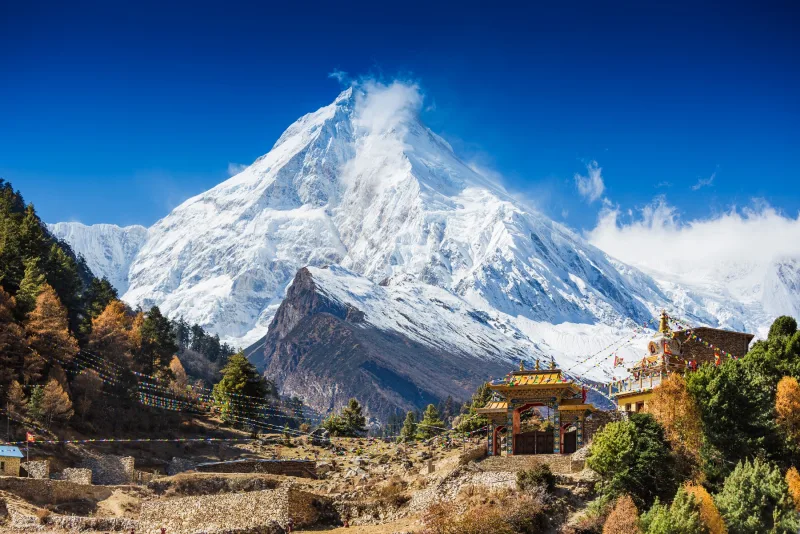
The Manaslu Circuit Trek for Indians is one of the best-kept secrets in Himalayan trekking, and as of March 2026, a rule change just made it significantly easier to get on. For years, Nepal required a minimum of two foreign trekkers before issuing a Manaslu Restricted Area Permit. That rule was scrapped on 22 March 2026. You can now apply solo. And almost nobody in India is talking about it yet.
That's the window. While the crowds pile onto Everest Base Camp (EBC) and the Annapurna Circuit, Manaslu stays gloriously quiet - genuine Tibetan Buddhist villages, no tea-house queues, no passing circus of selfie sticks at every ridge. If you've done the easier Nepal treks and want something that actually tests you, this is where you go next.
What Is the Manaslu Circuit Trek
The Manaslu Circuit is a high-altitude loop around Manaslu, the world's eighth-highest mountain at 8,163 metres. The route covers roughly 177 km, starting from the road-head at Soti Khola or Machha Khola and finishing at Dharapani on the Annapurna Circuit. The highest point is Larkya La Pass at 5,106 metres - Nepal's highest regularly trekked pass and the crown of the whole circuit.
Standard itineraries run 14 to 18 days depending on your acclimatisation schedule and whether you want a rest day at Samagaun for a side hike toward Manaslu Base Camp. Most trekkers walk 5 to 7 hours a day across varied terrain: river gorges, rhododendron forest, high alpine meadows, and finally the glaciated upper valley before the pass.
This is a restricted area. You need permits, a licensed guide, and some planning. None of it is complicated, but you can't just show up and start walking.
Why 2026 Is the Year to Do It
Three things align right now.
First, the solo permit rule was lifted in March 2026, removing the long-standing barrier that forced solo travellers to find a second foreign trekker before Nepal's Department of Immigration would issue a permit. You still need a licensed guide - that requirement remains. But you no longer need to find a stranger to stand next to you at the permit office.
Second, Manaslu is still genuinely uncrowded. EBC saw over 60,000 trekkers in 2023. Annapurna Circuit has stretches where it resembles a hill station on a Sunday. Manaslu's restricted-area status keeps visitor numbers low, and the trail infrastructure is simpler and quieter.
Third, the region around Samagaun and Lho has been quietly improving its teahouse quality. You're not roughing it anymore - but it's not a hotel corridor either.
Permits You Need as an Indian Trekker
This is where Indians actually have a cost advantage.
Manaslu Restricted Area Permit (MRAP): USD 100 per week during peak season (September to November), USD 75 per week during off-season (December to August). A standard 14-day circuit crosses two permit weeks, so expect USD 150 to 200 for this permit alone.
Manaslu Conservation Area Project (MCAP): USD 30, one-time fee. SAARC nationals - including Indians - pay NPR 200 instead, which works out to roughly INR 120 at current exchange rates. Confirm at the permit office before paying.
Annapurna Conservation Area Project (ACAP): USD 30, required if you exit via Dharapani (which most itineraries do). Same SAARC discount applies.
TIMS Card: USD 20, standard for all Nepal treks.
Key point for Indians: Your passport is from a SAARC nation. The MCAP and ACAP fees are dramatically lower for you. The MRAP is charged in USD to everyone. Permits are obtained in Kathmandu at the Nepal Tourism Board office or through a registered trekking agency. A guide is mandatory by law - no workaround.
The Route Stage by Stage
Kathmandu to Machha Khola (Day 1-2): Long drive, around 7 to 10 hours on roads that get progressively rougher after Arughat. Some groups break the drive with a night in Gorkha. The drive itself is part of the experience - the Budhi Gandaki river gorge is dramatic even from a jeep window.
Machha Khola to Deng (Days 3-5): Lower elevations, warm and humid. The trail follows the Budhi Gandaki through dense forest, past waterfalls and small villages. Altitude gain is gradual. This section is physically easier but the days are longer.
Deng to Lho via Namrung (Days 6-8): The valley opens up and the Tibetan influence starts showing in the architecture. Prayer flags, mani walls, stone monasteries. Lho at 3,180 metres gives you your first clear view of Manaslu's north face. Stop here, look, and recalibrate why you came.
Lho to Samagaun and Rest Day (Days 9-10): Samagaun at 3,530 metres is the largest village on the circuit. Take a full rest day here - it's not optional if you want to cross Larkya La safely. The hike to Manaslu Base Camp (4,800m) from here is a solid day trip for the fit and acclimatised.
Samagaun to Samdo to Dharmasala (Days 11-12): Short trekking days with heavy altitude gain. Samdo at 3,875 metres, then Dharmasala (also called Larkya Phedi) at 4,460 metres where you spend the night before the pass. Sleep is notoriously poor here. Most trekkers start the pass crossing by 4am.
Larkya La Pass to Bhimthang (Day 13): The climb to 5,106 metres in the dark, the crossing, and the long descent to Bhimthang at 3,590 metres. This is the day that defines the trek. Allow 8 to 10 hours. Go slow, drink water, don't rush the descent.
Bhimthang to Dharapani to Kathmandu (Days 14-16): The trail rejoins the Annapurna Circuit at Dharapani, then a drive back to Kathmandu via Besisahar. Two days of walking, one day of road.
What It Costs: A Real Budget Breakdown for Indians
The numbers below are directional. Prices vary by season (October costs 40 to 60% more than March), agency, and group size.
| Category | Budget Range (INR) |
|---|---|
| Return flight Delhi/Mumbai to Kathmandu | 14,000 - 35,000 |
| Permits (MRAP + MCAP + ACAP + TIMS) | 22,000 - 28,000 |
| Licensed guide (14-18 days, all-in) | 35,000 - 52,000 |
| Porter (optional, 14-18 days) | 22,000 - 30,000 |
| Teahouse accommodation (per night avg) | 500 - 1,500 |
| Meals (per day at teahouses) | 1,200 - 2,000 |
| Kathmandu hotel + airport transfers | 3,000 - 7,000 |
| Emergency reserve/incidentals (cash) | 8,000 - 12,000 |
| Total (solo, 16 days) | 1,05,000 - 1,70,000 |
Exchange note: USD/INR fluctuates. Budget USD 1,400 to 1,800 for a fully guided solo trek and convert at the rate prevailing when you book. Group packages from Indian operators start around INR 95,000 to 1,10,000 all-in.
Cash is non-negotiable. There are no ATMs, no UPI, no card swipes beyond Arughat. Carry all your Nepali Rupees from Kathmandu.
For a direct comparison of the big three Nepal treks, the Everest Base Camp Trek guide for Indians has a similar cost table. Manaslu generally comes in 15 to 25% cheaper than EBC, mostly because the accommodation infrastructure is simpler and there's less price gouging at altitude.
Manaslu vs EBC vs Annapurna: Honest Comparison
| Feature | Manaslu Circuit | Everest Base Camp | Annapurna Circuit |
|---|---|---|---|
| Max altitude | 5,106m (Larkya La) | 5,364m (Kala Patthar) | 5,416m (Thorong La) |
| Trek length | 14-18 days | 12-16 days | 12-21 days |
| Crowd level | Very low | Very high | Moderate-high |
| Guide mandatory | Yes | No | No |
| Permit complexity | High (restricted area) | Low | Low |
| Cost (INR estimate) | 1,05,000-1,70,000 | 1,25,000-1,85,000 | 80,000-1,30,000 |
| Cultural immersion | Tibetan Buddhist, authentic | Sherpa culture, well-touristed | Mixed Hindu-Buddhist |
| Best for | Experienced trekkers, crowd-haters | First Himalayan trek, iconic value | Beginners to intermediate |
The honest answer: if you've already done EBC or Annapurna and want something rawer, Manaslu is the clear step up. If this is your first high-altitude trek, do the Annapurna Base Camp Trek for beginners first and come back to Manaslu when you've got the altitude legs.
Difficulty and Fitness: What You Actually Need
Manaslu is rated moderate to challenging, 7 to 8 on a 10-point scale. Altitude is the main enemy, not technical terrain. Larkya La is a walk-up in good weather, not a climb. The challenge is cumulative fatigue over 16-plus days, the altitude at the pass, and the 10-hour day that crossing demands.
Minimum fitness baseline: - Can walk 20 to 25 km comfortably over hilly terrain - No prior AMS (Acute Mountain Sickness) history at altitude - Have trekked above 3,500 metres at least once before (or are going with an experienced guide who can read symptoms) - Training: 3 months of regular cardio and hiking before departure
You don't need mountaineering experience. You do need to take acclimatisation seriously. The mandatory rest day at Samagaun is not negotiable. Walk high, sleep low where possible.
Best Time to Trek: Spring vs Autumn
October is the best single month. Clear skies, stable weather, maximum mountain visibility, dry trails. The downside: it's the most popular month and prices are 40 to 60% higher. Book your guide and permits at least 4 to 6 months ahead for October.
April is second choice. Rhododendrons in bloom from 2,000 to 3,500 metres, warmer days, fewer trekkers. Weather is slightly less stable than October but still reliable.
March: Works but the higher elevations still have significant snow from winter. Larkya La can be difficult. Only attempt March with an experienced guide and confirmed conditions.
Monsoon (June to August): Avoid. Trail conditions are dangerous, leeches are abundant below 3,000 metres, and views are zero.
November: Possible but temperatures at altitude drop sharply. Nights at Dharmasala before the pass can hit -15 to -20 degrees Celsius.
Getting There from India
Direct flights from Delhi to Kathmandu run daily on IndiGo, Air India, Nepal Airlines, and others. Flight time is under 2 hours. Fares start from around INR 8,000 to 12,000 one way and can go up to INR 25,000 during October peak if you book late. Book at least 8 to 10 weeks out for reasonable prices.
From Mumbai, direct flights take around 2.5 hours. Fares are comparable to Delhi. Bangalore, Kolkata, and Chennai connections are typically one stop via Delhi.
Visa: Indian passport holders do NOT need a visa for Nepal. You cross on your Indian passport and fill a simple arrival card. This is one of the few places in the world an Indian passport gives you a direct advantage over most other nationalities paying USD 50 to 125 for a Nepal visa.
If you want to explore how Nepal compares to Bhutan for a first Himalayan trip, the Bhutan vs Nepal comparison for Indians breaks down both options clearly.
Packing for the Manaslu Circuit
Pack for alpine conditions and plan to carry no more than 10 to 12 kg if you have a porter taking your main bag.
Non-negotiables: - Down jacket (rated to -15 degrees Celsius minimum) - Waterproof shell jacket and trousers - Trekking poles (mandatory for Larkya La descent) - Headlamp with fresh batteries (the 4am pass start is in pitch dark) - Altitude sickness medication (Diamox, carry it, hope you don't need it - confirm dosage with a doctor before travel) - High SPF sunscreen and UV-protection sunglasses (glacier glare at 5,100m is intense) - Sleeping bag liner (teahouse blankets are thin above 4,000m)
For a detailed what-to-pack checklist for high-altitude treks, the trekking packing guide for India covers everything from base layers to blister prevention.
Teahouses and Food: What to Expect
Accommodation on the Manaslu Circuit is in locally run teahouses, not hotels. Rooms have basic wooden beds, thin mattresses, and shared squat toilets. Above 3,500 metres, hot showers are either solar-heated (unreliable) or available for an extra charge of NPR 200 to 500. Bring a sleeping bag liner.
Food is simple and caloric - exactly what you need. Dal bhat is the trek staple and comes in unlimited servings at most teahouses. Above Samagaun, expect noodle soups, momos, fried rice, and Tibetan bread. Menus shrink as altitude increases. Eating locally reduces your food budget and is far better fuel than imported snacks.
Teahouse costs: USD 5 to 10 per room per night at lower elevations, USD 15 to 25 at Dharmasala before the pass during peak season. Food adds another USD 20 to 30 per day for three meals.
Frequently Asked Questions
Can Indians do the Manaslu Circuit Trek without a guide?
Do Indians need a Nepal visa for the Manaslu trek?
What is the SAARC discount on Manaslu permits?
How fit do I need to be for the Manaslu Circuit?
When is the best time to do the Manaslu Circuit Trek from India?
How much does the Manaslu Circuit Trek cost for Indians in total?
One in the Orange Jacket runs offbeat group adventures for travellers who have outgrown the usual circuit.
Ready to do Manaslu with a crew that has actually been there? Check the OJ Manaslu Circuit group trek for current dates and what's included.