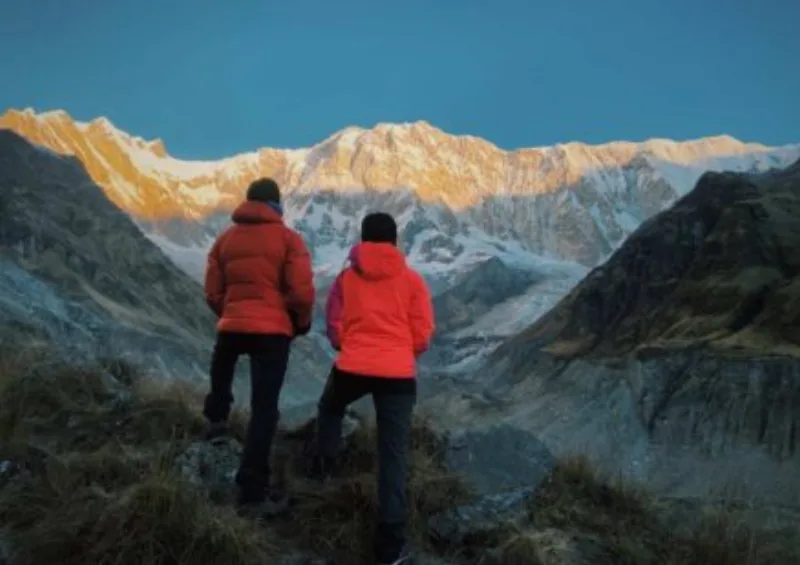
The Annapurna Base Camp trek is one of the most searched trek questions for Indian travellers, and the real answer is: yes, you can do it with zero prior trekking experience, as long as you are honest with yourself about fitness and spend a few months preparing. At 4,130 metres, ABC sits below the danger zone that Everest Base Camp (5,364 metres) occupies, oxygen levels are manageable, and the entire route runs through teahouses so you never sleep in a tent. Indians get in visa-free. Permits cost under INR 2,000. If there was ever a mountain bucket-list item designed for first-timers, this is it.
What Makes ABC Different From Other Himalayan Treks
Most high-altitude treks punish you with long approach roads, unpredictable weather, and altitude that climbs fast. ABC is forgiving by comparison. The route out of Pokhara takes you through Gurung villages, bamboo forests, and rhododendron groves before it opens up into the Annapurna Sanctuary, a natural amphitheatre ringed by eight peaks above 7,000 metres. You walk 5 to 7 hours a day on well-marked trails. There are teahouses every 2 to 4 hours of walking, so if someone in your group is struggling, you stop and rest. The highest you sleep is Machhapuchhre Base Camp at 3,700 metres, giving your body one night to adapt before you push the final 430 metres to ABC the next morning.
By contrast, the Manaslu Circuit trek crosses a 5,106-metre pass and requires a restricted-area permit on top of the standard ones. ABC is a gentler entry point to Himalayan trekking without feeling like a compromise.
The Honest Fitness Test
Can you walk for 5 to 6 hours continuously, including uphill, carrying a 5 to 7 kg daypack? That is the question. You do not need to run marathons. You do not need to have done a Himalayan trek before. But you do need to be able to keep walking when your legs are complaining and your lungs want a break.
Practical preparation that works:
- Walk or jog 45 minutes every day for 8 to 10 weeks before the trek
- Add stairclimbing sessions twice a week, because the trail has a lot of stone steps
- Do one or two day hikes of 15 to 20 km in the month before you leave
- Strengthen your quads and knees, as descents are hard on untrained legs
If you sit at a desk all day and have not exercised seriously in months, 8 weeks of consistent prep will get most people trail-ready. If you start training two weeks before departure, the trek will feel brutal.
Altitude: What Actually Happens at 4,130 Metres
This is the part beginners underestimate. At ABC, you are breathing roughly 60 percent of the oxygen you get at sea level. 25 to 30 percent of trekkers experience some form of Acute Mountain Sickness (AMS) above 3,000 metres, usually headaches, nausea, and fatigue. It is not a personal failing. It is physiology.
The good news: the ABC itinerary is designed to manage this. You gain altitude gradually, spend two nights between 2,000 and 3,000 metres, and only push to the higher camps at the end of the trek when your body has had time to adjust. The rule is simple: never ascend more than 300 to 500 metres per day above 3,000 metres, and always descend if symptoms get serious.
Practical things that actually help:
- Drink 3 to 4 litres of water per day on trail
- Avoid alcohol above 3,000 metres
- If a doctor clears it, Diamox (acetazolamide) is the standard medication for AMS prevention
- Spend the night at Machhapuchhre Base Camp (3,700 metres) before going to ABC, do not push through in one day
Altitude sickness is an equaliser. Fit people get it. Unfit people sometimes don't. The only reliable defence is pace and hydration.
Permits and Paperwork for Indian Trekkers
Here is the big advantage nobody tells you about enough: Indians do not need a visa for Nepal. You can enter on your passport or your voter ID card. That is one less thing to sort and one major cost removed from the budget.
For the trek itself, you need two permits:
| Permit | Cost for Indian/SAARC Citizens | Where to Get It |
|---|---|---|
| Annapurna Conservation Area Permit (ACAP) | NPR 2,000 (~INR 1,250) | Kathmandu or Pokhara Tourism Board |
| TIMS Card (Trekkers' Information Management System) | NPR 2,000 (~INR 1,250) | Same offices |
Total permit cost: roughly INR 2,500. Indian passport holders get the SAARC discount, which is significantly cheaper than what other nationalities pay. Both permits are obtained in Kathmandu or Pokhara, not online.
Carry the originals throughout the trek. There are checkpoints on the trail where they are verified.
The Route and How Many Days You Need
The classic ABC trek runs 7 to 10 days depending on your starting point and your pace. Most beginner-friendly itineraries look like this:
| Day | Route | Altitude |
|---|---|---|
| 1 | Pokhara to Nayapul, trek to Tikhedhunga or Ulleri | ~1,960 m |
| 2 | Trek to Ghorepani | 2,860 m |
| 3 | Poon Hill sunrise, trek to Tadapani | 2,630 m |
| 4 | Trek to Chhomrong | 2,170 m |
| 5 | Trek to Himalaya Hotel | 2,900 m |
| 6 | Trek to Deurali, then Machhapuchhre Base Camp | 3,700 m |
| 7 | Trek to Annapurna Base Camp and back to Bamboo | 4,130 m |
| 8 | Trek back to Chhomrong | 2,170 m |
| 9 | Trek to Jhinu Danda, natural hot springs | 1,760 m |
| 10 | Drive back to Pokhara | - |
The Poon Hill addition on Day 2 to 3 is optional but strongly recommended for first-timers. It adds one day and delivers a sunrise view of Dhaulagiri, Annapurna South, and Machhapuchhre that most people describe as the best hour of the entire trip.
If you are doing the Everest Base Camp trek for Indians as your next goal after ABC, this route is the best preparation because the daily gain is similar and you learn how your body responds to altitude before committing to EBC's harder schedule.
Cost Breakdown for Indian Travellers
Budget varies widely depending on whether you go with a group, hire a guide, or go solo. Here is a realistic range:
| Expense | Budget Option | Standard Option |
|---|---|---|
| Flights Delhi to Kathmandu | INR 8,000 to 12,000 one-way | INR 10,000 to 18,000 |
| Flights Mumbai to Kathmandu | INR 11,000 to 15,000 one-way | INR 14,000 to 22,000 |
| Pokhara bus from Kathmandu | INR 600 to 800 | Tourist bus: INR 1,000 to 1,500 |
| Teahouse accommodation (per night) | INR 300 to 600 | INR 800 to 1,500 |
| Meals on trail (per day, 3 meals) | INR 1,200 to 2,000 | INR 2,000 to 3,500 |
| Permits (ACAP + TIMS) | INR 2,500 total | INR 2,500 total |
| Porter (per day, per person sharing) | INR 1,500 to 2,000 | INR 2,000 to 3,000 |
| Guide (per day) | INR 2,500 to 3,500 | INR 3,500 to 5,000 |
A 10-day self-guided budget trek in a group costs roughly INR 25,000 to 35,000 on the ground, not counting flights. A fully guided comfortable version runs INR 40,000 to 60,000 on the ground. Confirm current figures with your agency, as teahouse rates and porter costs shift seasonally.
Teahouse rooms are cheap on purpose because the business model runs on food. You are expected to eat at the teahouse you sleep in. This is a cultural norm, not a rule, but it keeps the ecosystem working.
Should You Hire a Guide or Porter?
First-timers: hire at least a porter. The trail is waymarked but junctions exist where you can take the wrong path for half an hour. A guide eliminates that. More importantly for beginners, an experienced guide will notice early AMS symptoms before you do, pace you correctly, and know when to push and when to stop.
A porter takes your main pack (up to 15 kg), which transforms the daily walking from a grinding slog into something you can actually enjoy. You carry your daypack with water, snacks, a layer, and your camera. They carry everything else. Cost shared across two people is minor against the quality-of-experience difference.
Read what to pack for a trek in India before you finalize your kit. The packing principles overlap strongly with ABC, particularly around layering and footwear.
Best Time to Go From India
Two windows stand out:
October and November (autumn): Post-monsoon skies are the clearest you will see. The trails are dry, the rhododendrons are gone but the mountain views are unobstructed, and the temperature at ABC drops to -7 to -10 degrees Celsius at night. This is the busiest window but also the most reliable for summit views. October is the peak of peaks.
March and April (spring): Rhododendron forests between Jhinu Danda and Bamboo are in full bloom from mid-March. Views are good though occasionally interrupted by afternoon cloud. Slightly warmer than autumn. Lower trail sections can get muddy. Still an excellent choice.
Avoid June to August (monsoon season). The trail gets slippery, views disappear for weeks, and leeches are a constant companion at lower elevations. December and January are possible but cold at altitude, with some teahouses above 3,000 metres closing for the season.
What to Pack (The Non-Negotiables)
The ABC trek is a teahouse route, not a camping trek, which means you never carry a tent, sleeping pad, or cooking gear. Teahouses provide a bed and three meals. They do not always provide adequate blankets at higher altitudes.
Your kit must include:
- Down sleeping bag rated to at least -10 to -15 degrees Celsius (essential above 3,000 metres)
- Waterproof trekking boots with ankle support, broken in before the trek
- Trekking poles, both for ascending steep sections and protecting your knees on descent
- Layering system: moisture-wicking base, insulating mid-layer, waterproof shell
- Headlamp with spare batteries
- Water purification tablets or filter (stream water needs treating)
- High-SPF sunscreen and UV-blocking sunglasses, the sun at altitude burns fast
- Blister prevention and first-aid basics
Do not bring: full-frame camera bags, heavy jeans, cotton base layers (cotton stays wet), or more than one book.
Going With a Group vs. Going Solo
Solo trekking ABC is legal and manageable for the physically fit and experienced. For first-timers, a group has real advantages that go beyond cost sharing. You have built-in pace accountability, someone to notice if you are showing AMS symptoms, and the simple fact that shared pain is more bearable than solo misery.
Group travel also means shared porter and guide costs, which brings the daily rate per person down significantly. OJ runs group trips to ABC structured specifically for first-time Himalayan trekkers, with guides who pace conservatively and itineraries that do not cut the acclimatization days.
If you have done the Bhutan backpacking trip or similar high-altitude group travel before and know your body, solo or semi-independent is a reasonable step up. For your first-ever Himalayan trek, a guided group is the lower-risk, higher-fun choice.
How to Get There From India
By air: Delhi to Kathmandu takes 1.5 hours, with fares starting around INR 8,000 to 12,000 one way. Mumbai to Kathmandu is roughly 2.5 hours, starting around INR 11,000. IndiGo, Air India, and Nepal Airlines are the main operators. From Kathmandu, Pokhara is a 25 to 30-minute domestic flight (INR 6,000 to 12,000) or a 6 to 7-hour tourist bus (INR 800 to 1,200). The bus is scenic. The flight saves half a day.
By land: You can cross from the Indian border at Sonauli (near Gorakhpur) into Bhairahawa and bus or cab to Pokhara. This takes longer but works well if you are coming from Lucknow, Gorakhpur, or Varanasi and want to avoid a Kathmandu transit.
Entry documents: valid Indian passport or voter ID card. No visa, no extra fee at the border.
Frequently Asked Questions
Can someone who has never trekked before do the Annapurna Base Camp trek?
Do Indians need a visa to trek in Nepal?
How much does the Annapurna Base Camp trek cost from India in INR?
Is altitude sickness a real risk for beginners at ABC?
What is the best season for Annapurna Base Camp from India?
Is a guide mandatory for the ABC trek?
One in the Orange Jacket runs offbeat group adventures for travellers who have outgrown the usual circuit. See the Annapurna Base Camp group trek and check upcoming batches.