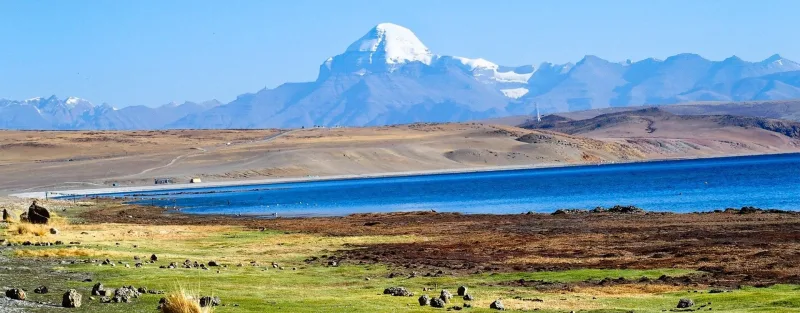
The Kailash Mansarovar Yatra 2026 is back. After years of disruption, the Ministry of External Affairs has officially reopened registrations for India's most demanding pilgrimage - a journey to Mount Kailash (6,638 m) and Lake Manasarovar (4,590 m) in the Tibetan Autonomous Region. If this has been on your list for a long time, 2026 is the year to move on it. But do not romanticise this trip. It is real, it is hard, and it will filter you before you even leave Delhi.
Here is everything you need to know - routes, real INR costs, the government process, fitness requirements, and what the Kora actually feels like on the ground.
What Is the Kailash Mansarovar Yatra and Why Is It Different From Other Pilgrimages
Mount Kailash sits in the far western corner of Tibet, revered simultaneously by Hindus, Buddhists, Jains, and followers of the Bon religion. It is considered the axis of the world, the seat of Shiva, the source of four great rivers. The Mansarovar lake at its foot is one of the highest freshwater lakes on earth. The three-day circumambulation of Kailash (the Kora or Parikrama) is 52 km of high-altitude trail, crossing the Dolma La Pass at 5,636 m - higher than Everest Base Camp by 100 m.
This is not a resort holiday or a spiritual retreat. It is physically hard, logistically complicated, and happens in one of the remotest places on earth. The Indian government runs a controlled official programme. Private operators run routes through Nepal. Both have their trade-offs.
The Two Official Government Routes in 2026
The Ministry of External Affairs (MEA) runs the pilgrimage through kmy.gov.in. In 2026, 1,000 pilgrims will travel in 20 batches of 50.
Route 1 - Lipulekh Pass (Uttarakhand)
- 10 batches travel this route
- Duration: approximately 22 days
- Government estimated cost: INR 2.09 lakh per person
- Higher physical demand - involves more actual trekking through Uttarakhand before crossing into Tibet
- Traditional route used for decades
- Crosses the Lipulekh Pass at around 5,334 m
Route 2 - Nathu La Pass (Sikkim)
- 10 batches travel this route
- Duration: approximately 21 days
- Government estimated cost: INR 3.31 lakh per person
- Comparatively less strenuous - more of the journey is by vehicle
- The highest point on this route is around 4,310 m before entering Tibet
- More expensive due to helicopter use within Tibet
For fit trekkers comfortable at altitude, the Lipulekh route is the real deal - more immersive, more traditional, and significantly cheaper.
The Nepal Private Route - Via Simikot and Hilsa
If you miss the MEA registration deadline or do not get selected in the computerized draw, the Nepal route is the serious alternative used by thousands of pilgrims each year.
Route: Delhi - Kathmandu - Nepalgunj - Simikot (via charter flight) - Hilsa (Nepal-Tibet border on foot or by jeep) - Purang - Mansarovar - Kailash Kora - return
Duration: 15 to 20 days depending on operator and pace
Cost in INR: Private packages via Nepal typically run INR 1.4 lakh to INR 2.8 lakh per person for standard group tours (USD 1,600 to USD 3,400 range at current rates). Premium options with better accommodation and smaller groups push to INR 4 lakh and above.
What is included in most packages: flights within Nepal, Tibet permits, accommodation, meals, guide, horse/yak support on the Kora. What is usually not included: your Delhi-Kathmandu flight, travel insurance, and personal expenses.
The Nepal route does not require MEA registration and runs more flexibly through the June-September window.
2026 Cost Comparison Table
| Route | Duration | Approx INR Cost | Trekking Level |
|---|---|---|---|
| MEA - Lipulekh Pass | 22 days | INR 2.09 lakh | High |
| MEA - Nathu La Pass | 21 days | INR 3.31 lakh | Moderate |
| Nepal Private (standard group) | 15-20 days | INR 1.4L - 2.8L | Moderate-High |
| Nepal Private (premium) | 12-15 days | INR 4L+ | Moderate |
| Helicopter (Nepal-based, 5-7 days) | 5-7 days | INR 5L - 8L | Low |
Note: government costs are the MEA published estimates for the 2026 yatra. Private operator prices vary significantly. Confirm current rates directly with operators or at kmy.gov.in. Exchange rates affect Nepal-based packages.
How to Register for the 2026 MEA Yatra
The 2026 registration opened on May 1, 2026 at kmy.gov.in and closes May 19, 2026. If you are reading this after that date, note it for 2027 - the window is typically 2-3 weeks in late April or May.
Steps for MEA registration:
1. Create an account at kmy.gov.in - name, date of birth, phone, email 2. Fill the online application and choose your preferred route (Lipulekh or Nathu La) 3. Submit - no physical documents required at this stage 4. Wait for the computerized lottery draw result (notified by email and SMS) 5. If selected, pay INR 5,000 non-refundable confirmation deposit and report to Delhi for medical tests
Eligibility for MEA route: - Indian citizen with a valid ordinary passport (not diplomatic) - Passport validity must extend at least 6 months beyond September 2026 - Age: 18 to 70 years - BMI: 25 or below - No serious medical conditions (heart disease, asthma, uncontrolled diabetes, hypertension, epilepsy)
The selection is by computerized random draw. Gender balance is factored in. About 1,000 spots for the entire country, which means it is competitive. A lot of applicants do not get through in any given year.
The Medical Tests - What to Expect in Delhi
Selected pilgrims must assemble in New Delhi 3 to 4 days before their batch departure for mandatory medical screening. This happens at the Delhi Heart and Lung Institute (DHLI) and ITBP Base Hospital.
Tests typically include:
- ECG at rest (and sometimes stress ECG / treadmill for applicants over 50)
- Blood pressure check (must be below 140/90 mmHg without medication as a baseline)
- Oxygen saturation (SpO2) - baseline at sea level should be 95% or above
- Chest X-ray - screens for respiratory issues that become dangerous at altitude
- Blood tests - sugar, hemoglobin
- BMI measurement
What can disqualify you: uncontrolled hypertension, cardiac abnormalities on ECG, low baseline SpO2, respiratory disease, uncontrolled diabetes, active epilepsy.
If you fail the Delhi medical screening, you cannot proceed that year. There is no re-test. This is not a formality. A meaningful number of registered pilgrims are turned away at this stage every year.
The Tibet Permits You Need (and Who Handles Them)
Tibet is not a standard tourist destination. All visitors, including Indians, require multiple permits beyond just a China visa.
For MEA government yatra participants: the Ministry of External Affairs arranges the Chinese Group Visa and Tibet Travel Permit on your behalf. You do not apply individually. This is one of the significant advantages of the government route.
For Nepal-route private travellers: your tour operator in Nepal handles the Tibet Travel Permit, Alien Travel Permit, and Military Area Permit for the Kailash-Mansarovar region. Indian passport holders cannot get an individual China tourist visa for Tibet - group visa through an authorized operator is the only legal route. The operator's authorization to handle Tibet permits is something to verify before booking.
Additional permits for Kailash region: beyond the basic Tibet Travel Permit, a Frontier Pass and Military Area Permit are required for the western Tibet zones where Kailash is located. All of these are bundled into any legitimate Kailash package.
Fitness Preparation - What to Do Before You Go
The Kailash Kora is 52 km over three days, reaching 5,636 m at Dolma La Pass. The altitude is more brutal than the distance. Here is a realistic preparation plan:
6 months before: - Start regular cardio - running, cycling, swimming. Build to 45-60 minutes daily. - Introduce trekking on weekends with a loaded backpack (8-10 kg minimum). - If you smoke, stop. High-altitude oxygen is not negotiable.
3 months before: - At least two multi-day treks above 3,000 m. Kedarnath, Roopkund, Valley of Flowers, Hampta Pass - these all work as preparation and altitude exposure. - Check BMI. If you are above 25, you will fail the MEA medical. Start early.
On the journey: - Acclimatize properly - do not rush from Delhi to Darchen (4,600 m) in two days. - Most good itineraries include 2-3 nights in Lhasa (3,650 m) and a stop in Shigatse (3,800 m) before reaching the Kailash area. - Carry Diamox (acetazolamide) for altitude sickness prevention. Discuss dosage with your doctor before departure. - Stay hydrated. At high altitude your body loses moisture faster than you feel thirsty. - The inner Kora (a shorter, higher circuit done by very few pilgrims) is a separate challenge entirely. Do not attempt it on your first yatra.
June, July or August - When Is the Best Time
The MEA yatra operates June to August because these are the only months the passes are reliably open. Among these:
June is widely considered the best month. Longer days, stable weather on the Tibetan plateau, temperatures between 11-15°C in daytime, and the skies around Kailash tend to be clearest. The landscape is vivid after snowmelt.
July and August are the peak months for the Nepal-side monsoon. While western Tibet itself receives significantly less rain than Nepal or India, the access routes through Nepal and even the Lipulekh approaches can be affected by landslides and road damage. July and August are workable but carry more weather risk on the approach.
If you have a choice, aim for a June batch or early July. If you are on the Nepal route, June or September are the cleaner options.
Private vs Government Route - Which One Makes More Sense
This question comes up constantly. Here is an honest breakdown:
Choose the MEA government route if: - You want the most affordable option and can wait for the selection draw - You prefer the classic Lipulekh trekking experience - You are comfortable with a fixed, structured government itinerary and co-travellers you did not choose - You have the time (22 days is a long commitment)
Choose a private Nepal-based operator if: - You missed the MEA registration window - You want more control over pace, group size, and accommodation quality - You are coming from outside India and the Nepal approach is geographically simpler - You want to book with more certainty rather than going through a lottery
Both routes get you to the same Kora. The mountain does not care which way you arrived.
What the Kora Actually Feels Like
The three-day Kailash Kora is the centrepiece of the entire journey. Day 1 is manageable - about 22 km from Darchen to Dirapuk, following the Lha Chu valley with the north face of Kailash visible for most of the walk. You sleep at Dirapuk guest house (4,890 m).
Day 2 is the one that matters. The 8 km climb to Dolma La Pass (5,636 m) begins at 4 AM in most itineraries. The altitude hits hard here. Many pilgrims move extremely slowly. Some need assistance. The descent to Zuthulpuk (4,790 m) is another 10 km after the pass. This is a 22 km day at altitudes most Indians have never experienced.
Day 3 is the return to Darchen - 14 km downhill, usually completed by noon.
The Kora changes people. Whether you are doing it for religious reasons, personal challenge, or just to stand in one of the most remote landscapes on earth - the experience is its own kind of argument. Most people who go, want to go back.
Frequently Asked Questions
Is the Kailash Mansarovar Yatra 2026 registration still open?
The MEA registration window for 2026 closed on May 19, 2026. If you have missed it, the next opportunity via the government route will be the 2027 registration, typically opening in April or May. For 2026, private operators running the Nepal route still have availability. Check directly with Nepal-based Kailash tour operators for June-September 2026 slots.
Do Indians need a China visa for Kailash Mansarovar?
Yes, Tibet is administered by China and Indian passport holders need a Chinese Group Visa plus a Tibet Travel Permit. Indian citizens cannot obtain an individual China tourist visa for Tibet - it must be a group visa processed through an authorized tour operator or, in the case of the government yatra, handled by the MEA. Do not book anything without confirming this paperwork chain is covered.
What is the minimum fitness level required?
For the MEA route, a BMI of 25 or below and passing the Delhi medical tests is the formal threshold. Practically, you should be able to walk 10-12 km per day with a daypack at altitude without significant distress. Prior high-altitude trekking experience (above 3,500 m) is strongly recommended. The Dolma La day on the Kora reaches 5,636 m - this is not a beginner altitude experience.
Can someone above 60 do the yatra?
The MEA allows applicants up to 70 years. Age itself is not the barrier - cardiovascular fitness is. Many pilgrims in their 60s complete the Kora without difficulty. The medical screening in Delhi will flag any genuine health concerns. If you are above 55, take the preparation phase more seriously and get a full cardiac evaluation done before applying, not after selection.
What is the difference between the inner Kora and outer Kora?
The outer Kora is the standard 52 km circumambulation done by most pilgrims over three days. The inner Kora is a shorter but significantly more demanding circuit at higher altitude, considered sacred for a second or subsequent visit. It involves crossing the Nandi Parikrama and requires prior completion of the outer Kora. Most first-time yatris should not attempt the inner Kora.
Is the yatra safe from a geopolitical standpoint?
The Indian government managing the yatra directly, and China issuing group permits via established bilateral channels, means this route has operated for decades with a reasonable track record. Disruptions have occurred in the past - COVID paused the yatra from 2020 to 2023, and India-China border tensions in 2019-2020 affected some years. The 2026 resumption is a positive sign, but travel advisories from MEA should be checked at kmy.gov.in before any bookings are finalized with private operators too.
Related Reading
Planning more high-altitude travel this year? Our Pamir Highway guide, Kyrgyzstan trip from India and Mongolia trip from India cover three more routes across the roof of Asia.
One in the Orange Jacket runs offbeat group adventures for travellers who have outgrown the usual circuit.