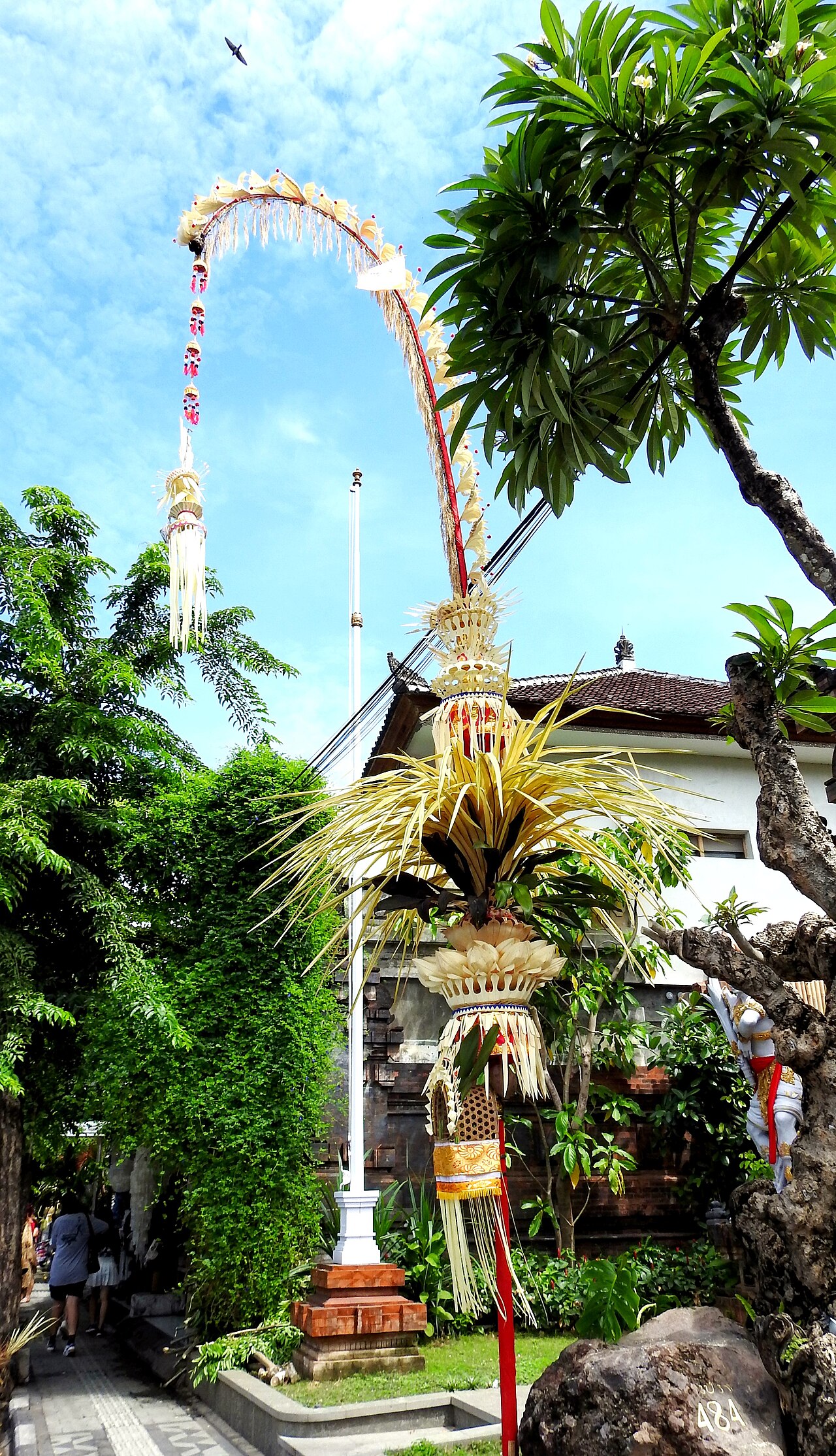
If you are lucky enough to be in Bali during Galungan, you will see the island transform. Every street, every family compound, every roadside is lined with penjor, tall, gracefully arching bamboo poles, beautifully decorated with palm leaves, flowers, and offerings, curving over the roads like a guard of honour. This is Galungan, the most important holiday in the Balinese Hindu calendar, when the ancestral spirits return to earth and the whole island dresses itself in beauty to welcome them and to celebrate the victory of good over evil.
The victory of dharma over adharma
Galungan celebrates the triumph of dharma, order and goodness, over adharma, chaos and evil, a theme that runs through Balinese Hindu belief. It marks a time when the spirits of ancestors descend to visit the family homes and the world of the living, and the Balinese prepare to receive them with elaborate offerings, prayers, and ceremonies. It is a deeply spiritual celebration of cosmic and moral order, and of the bond between the living and their ancestors.
The festival follows the Balinese pawukon calendar, a 210-day cycle, so Galungan comes around roughly twice in a Western year rather than annually, and its timing shifts accordingly. It unfolds over a period of days and culminates ten days later in Kuningan, the day the ancestral spirits return to the heavens, when further offerings send them off. Together, Galungan and Kuningan form the spiritual high point of the Balinese year.
The penjor are not decoration. Each curving bamboo pole is a prayer of gratitude, bowing over the road to honour the spirits and the mountain that feeds the island.
On the penjor
The penjor and the offerings
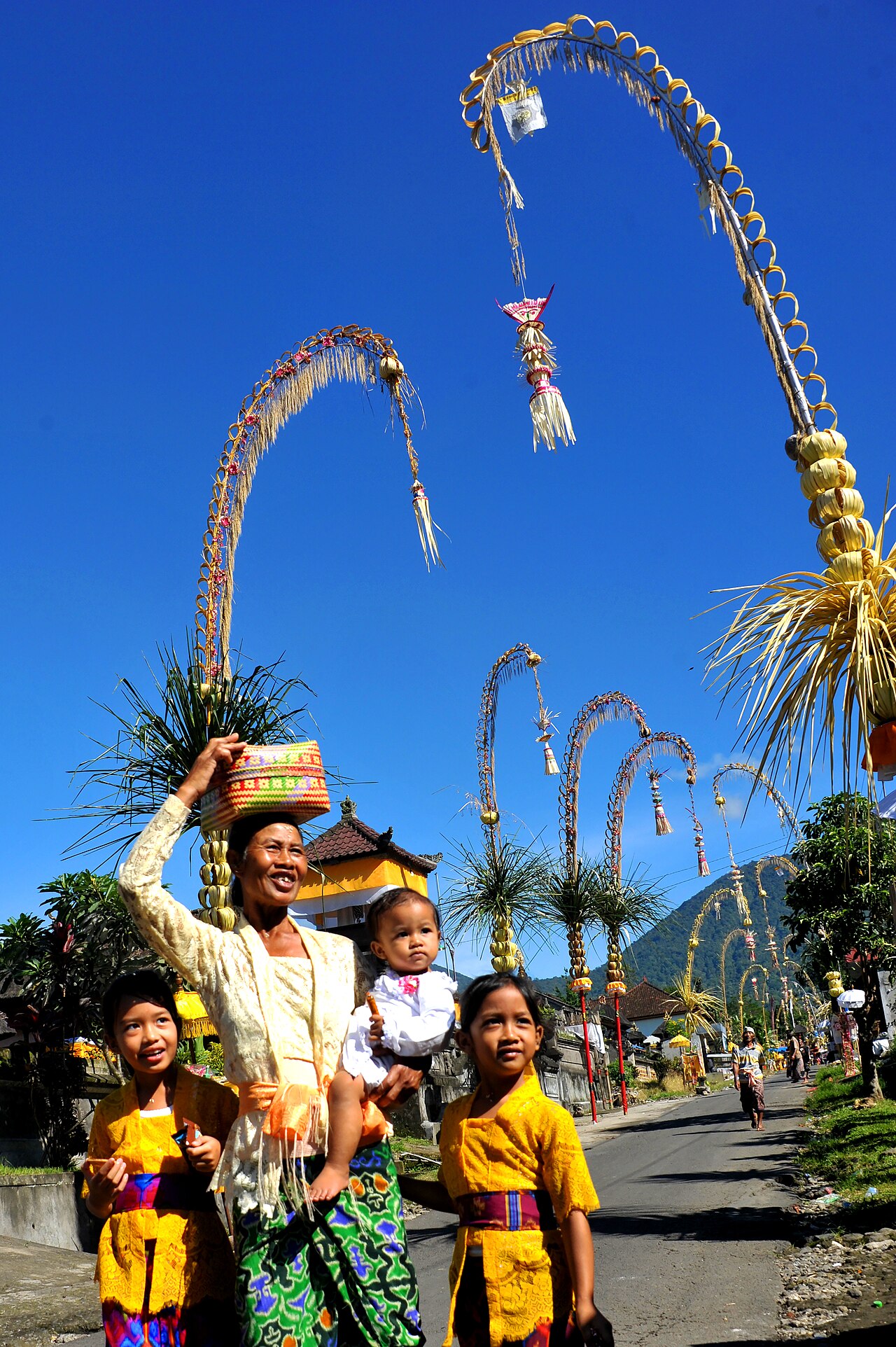
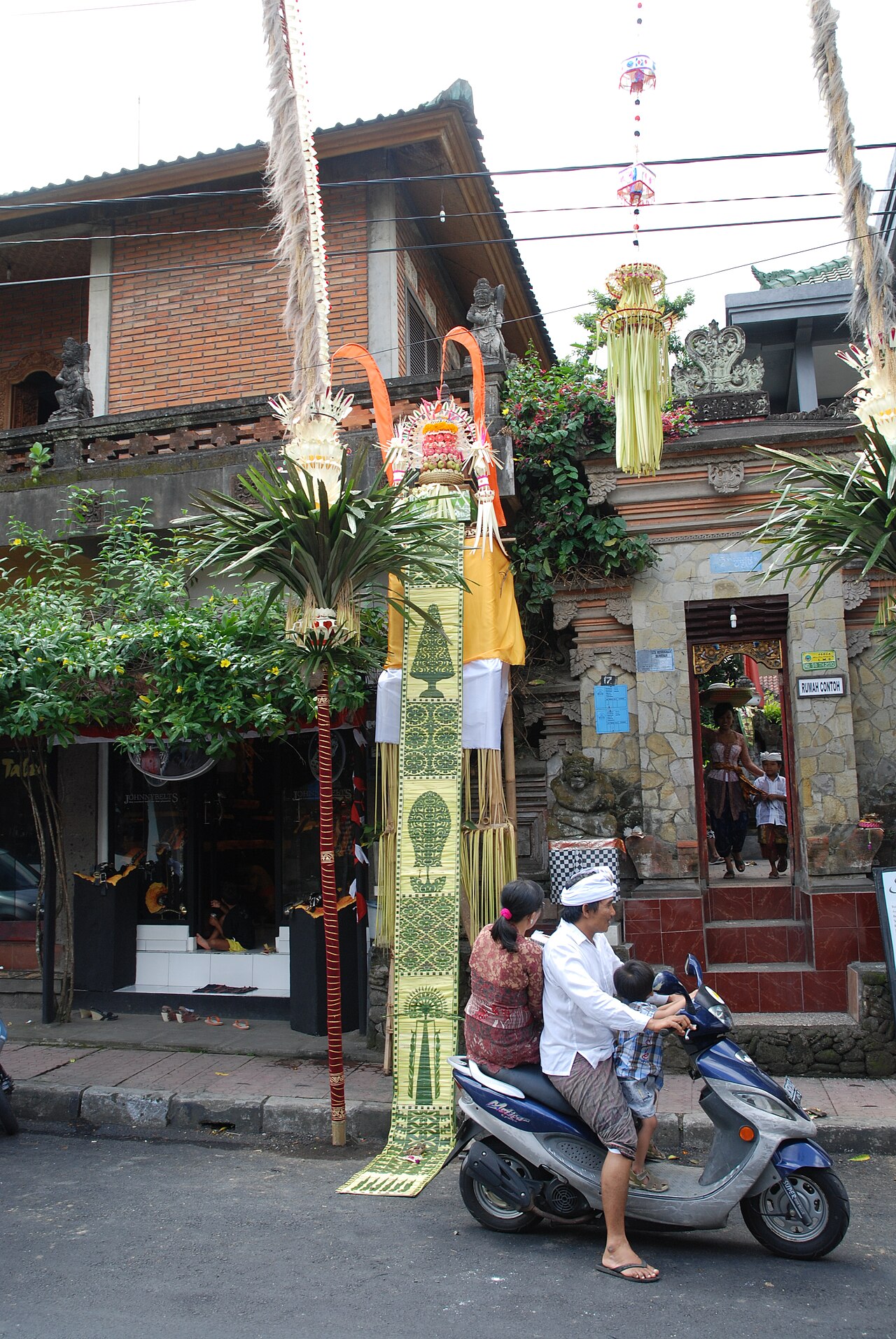
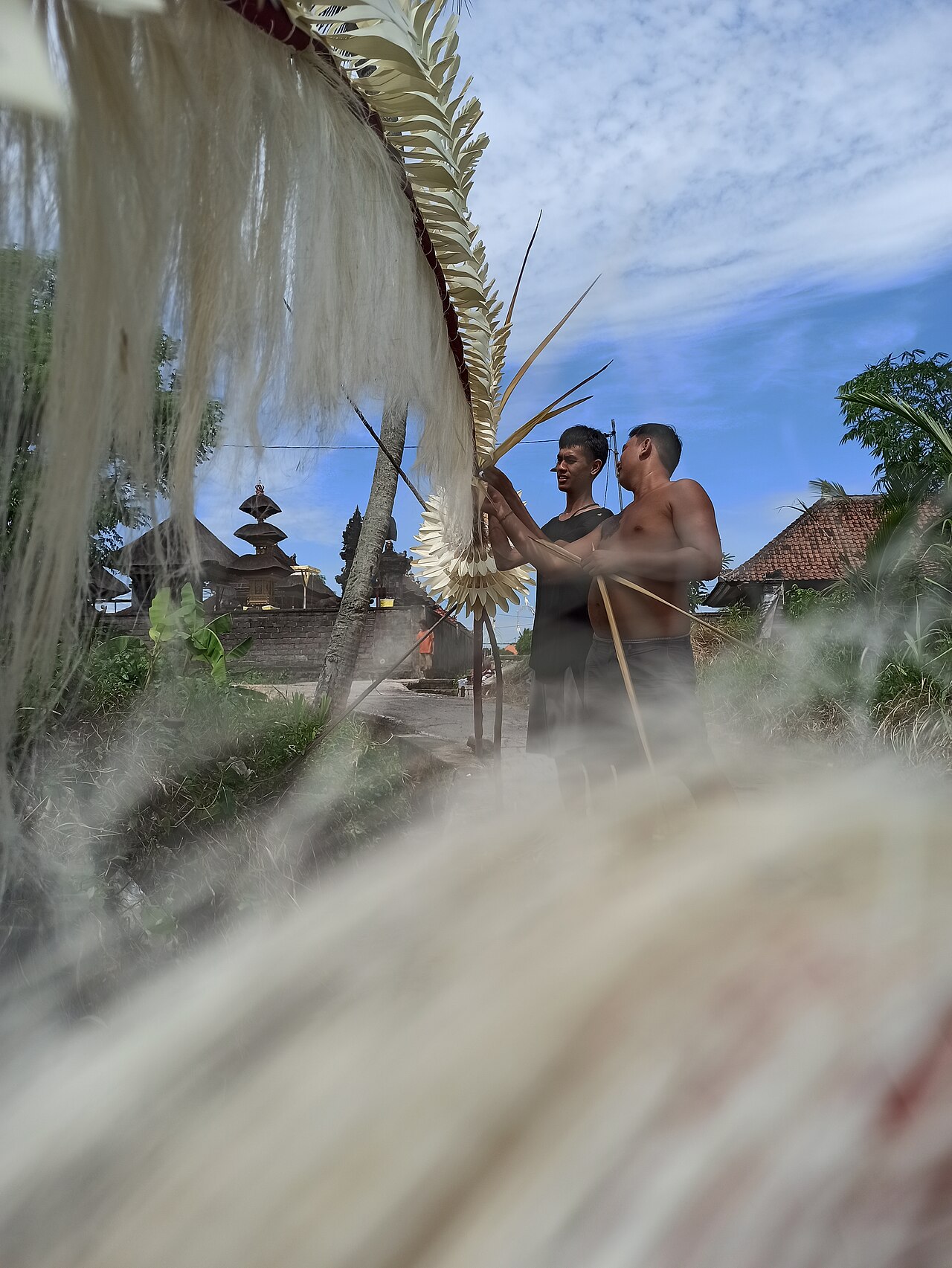
The most striking sight of Galungan is the penjor: tall bamboo poles, often several metres high, that arc gracefully over the right-hand side of every street and home entrance. Each is laboriously and lovingly decorated with young coconut leaves, fruit, flowers, cakes, and a small shrine at its base, and the curve is symbolic, said to represent gratitude and to honour the sacred mountain and the gods. An island lined with hundreds of these golden, arching poles is one of the most beautiful sights in Balinese culture.
Beyond the penjor, Galungan is a time of intense ceremony. Families dress in their finest temple attire, sarongs and sashes, and visit their family and village temples to pray and present offerings. The compounds fill with the canang sari, the small daily offerings, multiplied for the occasion. It is a profoundly communal and devotional time, the island at its most sacred and its most beautiful at once.
How to experience it respectfully
- Check the Balinese calendar. Galungan follows a 210-day cycle, so it occurs roughly twice a Western year on shifting dates. Confirm whether your visit aligns.
- It is deeply religious, not a tourist show. Watch the ceremonies and admire the penjor with respect and humility, as a privileged guest.
- Dress properly for temples. A sarong and sash are required to enter, and modest, respectful dress is expected during the ceremonies.
- Do not intrude on family rites or offerings. Observe from a respectful distance and always ask before photographing people at prayer.
- Expect a quieter, more inward Bali. Many Balinese focus on family and temple, so it is a time to witness the island's spiritual life rather than its nightlife.
The soul beneath the island
Most visitors know Bali as a place of beaches, rice terraces, and wellness retreats, and miss the extraordinary spiritual life that animates everything. Galungan pulls that hidden world to the surface. To walk a Balinese street lined with hundreds of golden penjor, past families in white and gold carrying offerings to the temple, is to understand that Bali is not a beach destination that happens to be Hindu, but a profoundly religious island whose every street and gesture is shaped by devotion. The beaches are the surface; Galungan is the soul.
Bali's beaches are what you book. The island lined with bowing bamboo, welcoming its ancestors home, is what you will never forget.
On the OJ Bali trip we steer toward this deeper, sacred Bali, the temples, the offerings, the rhythm of an island shaped by faith, and where the timing aligns, the beauty of a festival like Galungan. Because the beach clubs and the rice terraces are the postcard, but an island that lines its every street with arching bamboo to welcome its ancestors home is the real Bali, and it is far more beautiful than the brochure.
Frequently asked
When is Galungan celebrated in Bali?
Galungan follows the Balinese pawukon calendar, a 210-day cycle, so it occurs roughly twice in a Western year on shifting dates rather than annually. It unfolds over several days and culminates ten days later in Kuningan. Because the timing changes, check the Balinese calendar to see whether your visit aligns with the festival.
What are the bamboo poles during Galungan?
They are penjor, tall bamboo poles that arch gracefully over the streets and home entrances during Galungan, decorated with young coconut leaves, fruit, flowers, and a small shrine at the base. The curving shape symbolises gratitude and honours the gods and the sacred mountain. An island lined with hundreds of them is one of the most beautiful sights in Balinese culture.
What does Galungan celebrate?
Galungan celebrates the victory of dharma, goodness and order, over adharma, chaos and evil, and marks the time when ancestral spirits return to visit the world of the living. Balinese families welcome them with elaborate offerings, prayers, temple visits, and the decorative penjor poles. It is the most important holiday in the Balinese Hindu calendar, ending with Kuningan.