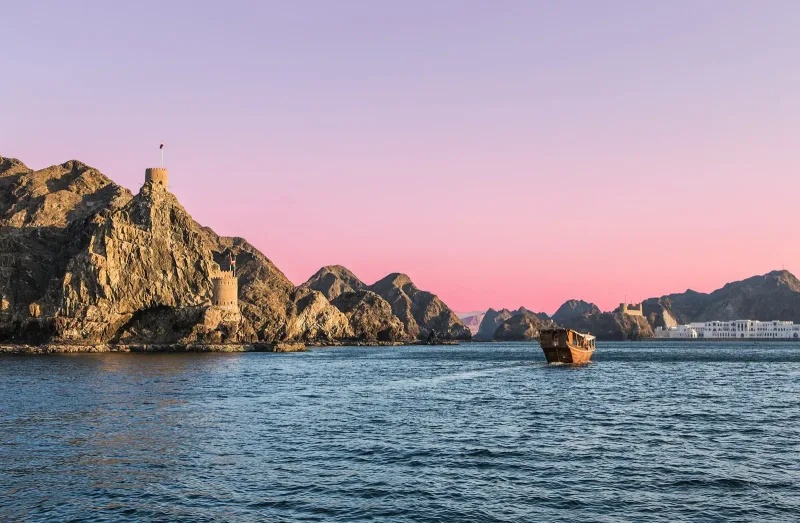
Oman is the kind of country that makes you wonder why you spent money on Bali. It is visa-free (with conditions), direct flights from India cost under Rs. 20,000 return if you book three months ahead, and the landscapes, fjords, canyons, sand dunes, and turquoise wadis are the sort of thing that ends up as your phone wallpaper for a year. This guide covers the Oman trip from India end to end: visa options for Indian passport holders, a realistic 7-day itinerary hitting the big stops, and a full INR cost breakdown that does not pretend you can do it on Rs. 50,000 total.
Who Should Go to Oman (And Who Should Not)
Oman rewards the traveller who wants something real. The souqs smell of frankincense rather than perfume testers. The fort in Nizwa is genuinely 17th century and feels like it. Wadi Shab involves climbing over boulders and swimming through a canyon, not taking a lift to a viewpoint. If your idea of a good trip is a rooftop pool and a Zomato-friendly neighbourhood, this is not your destination.
If you are a 20-35 year old Indian traveller who has done the standard Southeast Asia circuit, Oman is the logical next level. The country is safe, conservative but welcoming to tourists, and short enough from India (under 3 hours from Mumbai) that it fits neatly into a week of casual leave.
Oman Visa for Indian Passport Holders: The Real Situation
This is where most Indian travel blogs mislead you, so pay attention.
Indians cannot simply show up and get a visa on arrival in Oman without conditions. There is no blanket visa-free access for Indian passports. Here is how it actually works:
Option 1 - e-Visa (the standard route): Apply online at evisa.rop.gov.om at least four days before travel. A 30-day single-entry tourist e-visa costs OMR 20, which is approximately Rs. 4,400. Processing is 1-3 working days. This is the route most Indians use.
Option 2 - Visa on arrival (if you qualify): If you hold a valid visa to the US, UK, Canada, Australia, Japan, or a Schengen country, you can get an Oman visa on arrival for 14 days. The fee is OMR 20 (approximately Rs. 4,400), paid in Omani Rials or by card at the immigration counter.
What you need for the e-visa: passport with 6 months validity, return flight ticket, hotel booking confirmation, bank statement showing sufficient funds (around Rs. 2 lakh for a comfortable margin), and a passport-size photo.
Always confirm the current rules at the official Oman eVisa portal or the Royal Oman Police website before you travel, as these policies do shift. Oman has been moving toward broader visa liberalisation and the rules in 2026 may have updated since this was written.
Flights From India to Muscat: What to Pay
Muscat International Airport (MCT) is well connected to India. IndiGo, Air India, and Oman Air all operate direct routes. Here is the realistic picture:
| Route | Approx. Return Fare (Economy, booked 2-3 months ahead) |
|---|---|
| Mumbai to Muscat | Rs. 14,000 - Rs. 22,000 |
| Delhi to Muscat | Rs. 18,000 - Rs. 28,000 |
| Kochi to Muscat | Rs. 10,000 - Rs. 16,000 |
| Hyderabad to Muscat | Rs. 12,000 - Rs. 20,000 |
| Chennai to Muscat | Rs. 12,000 - Rs. 18,000 |
Flight time from Mumbai is under 3 hours. From Delhi, approximately 3.5 hours. Kochi and Chennai are the cheapest departure points because of the large Keralite and Tamil diaspora working in Oman, which keeps those routes competitive year-round.
Book 8-12 weeks out for the best prices. Flying on weekdays (Tuesday, Wednesday) typically saves 10-15% versus weekends.
The 7-Day Oman Itinerary: Muscat to Desert to Wadi to Coast
This itinerary covers the classic northern Oman circuit that most first-time Indian travellers do. It hits every major type of landscape the country offers without exhausting you.
Day 1 - Muscat arrival and Mutrah Corniche Land in the morning, collect a rental car (the only sensible way to move around Oman), and head to Mutrah Corniche. Walk the waterfront, browse the Mutrah Souq for Omani silver, frankincense, and khanjar daggers. In the evening, catch sunset from the Al-Jalali fort area overlooking the harbour. Budget your evening around the corniche - meals here are cheap and genuinely good.
Day 2 - Muscat proper: Sultan Qaboos Grand Mosque and Muttrah The Sultan Qaboos Grand Mosque is one of the most impressive pieces of architecture in the Middle East. Arrive early (it opens to non-Muslims from 8am to 11am, closed Friday). The main prayer hall is over 4,000 square metres of hand-loomed carpet, stitched by 600 Iranian craftswomen over 4 years. After the mosque, visit the Royal Opera House exterior and the newer Qurum Beach area before heading back toward Muttrah for dinner.
Day 3 - Nizwa Fort and the Green Mountain (Jebel Akhdar) Drive 2 hours inland to Nizwa. The fort dates to the 1650s and the restoration is thorough. The adjacent Nizwa Souq has the best silver market in the country - Friday mornings bring a goat market that is unlike anything you will have seen. After Nizwa, drive up to Jebel Akhdar (the Green Mountain) at 2,000 metres elevation. The plateau is noticeably cooler, lined with rose and pomegranate orchards. Note: the road up requires a 4WD vehicle - the gate attendants enforce this.
Day 4 - Wahiba Sands desert camp Head to the Wahiba (Sharqiyah) Sands, a 10,000 square kilometre desert of orange-red dunes. Most camps run dune-bashing sessions in the late afternoon, followed by a Bedouin dinner under the stars with fire and traditional music. Stay overnight in a desert camp - this is one of the better nights you will have on any trip. Dune buggies are available at most camps at an extra Rs. 2,000-3,000 per person.
Day 5 - Wadi Bani Khalid and Wadi Shab These two wadis are both within reach of the desert base. Wadi Bani Khalid is easier, with crystal-blue natural pools surrounded by palm trees - good for families or those who do not want to hike. Wadi Shab is the serious one: take a 1 OMR (Rs. 220) rowboat across, then hike 45 minutes over boulders, wade through shallow sections, and swim through a narrow canyon slot to reach a hidden waterfall cave. Do this. It is one of the genuinely rare travel experiences available in the region.
Day 6 - Sur and the coast Sur was historically Oman's greatest dhow-building port. The traditional boatyard at Sur still hand-builds wooden dhows. Visit Ras Al-Jinz nearby if turtles are in season (turtle nesting season runs June to August, hatching November to January). The coastline along this section is completely undeveloped and the water is clear. Drive back toward Muscat or stay another night on the coast.
Day 7 - Bimmah Sinkhole and departure On the way back to Muscat, stop at the Bimmah Sinkhole - a collapsed limestone cavern filled with turquoise brackish water, with fish visible at the surface. It sits just off the main highway and takes 30 minutes. Return the car, fly home.
Full INR Budget Breakdown for 7 Days
This table assumes two travellers sharing accommodation and a rental car. Solo travellers should add 30-40% to the accommodation and transport lines.
| Expense | Budget (per person) | Mid-Range (per person) |
|---|---|---|
| Return flights (Mumbai base) | Rs. 14,000 | Rs. 22,000 |
| Oman e-visa | Rs. 4,400 | Rs. 4,400 |
| Accommodation (7 nights, shared) | Rs. 10,500 | Rs. 21,000 |
| Rental car (7 days, shared) | Rs. 6,000 | Rs. 10,500 |
| Food (7 days, mix of local and sit-down) | Rs. 8,000 | Rs. 14,000 |
| Desert camp (1 night, inclusive) | Rs. 5,500 | Rs. 9,000 |
| Activities and entry fees | Rs. 3,500 | Rs. 6,000 |
| Travel insurance | Rs. 2,000 | Rs. 2,500 |
| Total per person | Rs. 53,900 | Rs. 89,400 |
A lean trip with advance booking and budget hotels is doable around Rs. 55,000-65,000 per person including flights. Mid-range comfort with decent hotels and a proper desert camp sits at Rs. 85,000-1,00,000 per person. The major levers are flight timing (book early), accommodation sharing, and whether you go with a pre-organised group or arrange everything independently.
For comparison, a comparable 7-day Vietnam trip from India costs roughly the same in the budget tier but requires more logistical management across multiple cities - see our Vietnam trip cost from India guide for the full breakdown.
Best Time to Visit Oman From India
October to March is the window that almost every Indian traveller should target. Muscat temperatures range between 22 and 30 degrees Celsius during these months, which is genuinely comfortable for outdoor activities like wadi hiking and dune exploration.
| Month | Weather | Notes |
|---|---|---|
| October - November | Pleasant, 25-32°C | Festival season, good hotel availability |
| December - February | Cool, 18-28°C | Peak season, slightly higher prices |
| March - April | Warming, 25-35°C | Shoulder season, good value |
| May - September | Hot to extremely hot, 38-48°C | Not recommended for outdoor-heavy itineraries |
The Khareef (monsoon) season in Salalah (southern Oman) runs June to September and is actually a draw for some travellers - the southern coast turns green and misty, which is unusual for the region. But Salalah is a separate trip from the northern circuit covered above.
Getting Around: Rent a Car, Not a Tour Bus
Oman is a country built for road trips. Distances between attractions are real, public transport between cities is limited, and having your own car means you can stop at a wadi you spotted on the drive without negotiating with a driver. A standard sedan works for most of the northern circuit except Jebel Akhdar, which requires a 4WD. Many groups rent a sedan for the main circuit and switch to a 4WD day-hire for the mountain day.
Car rental in Oman costs approximately Rs. 1,500-2,500 per day for a standard sedan (via Budget, Thrifty, or local operators), and Rs. 3,000-4,500 per day for a 4WD. International driving licences are recognised, and Indian driving licences with an Oman e-visa are generally accepted at most rental counters - confirm with the operator before arriving.
Petrol is cheap in Oman - fuel costs for a 7-day road trip covering 800-1,000 km would come to roughly Rs. 2,500-3,500 in total, split across the group.
What to Eat in Oman (And What It Costs)
Omani food is underrated. Shuwa (slow-cooked marinated lamb wrapped in banana leaves and buried in a sand pit for hours) is the national dish and worth seeking out at a traditional restaurant. Mashuai (roasted kingfish with lemon rice) is the Muscat street specialty. Shawarma here is on a different level from what you get in Indian Lebanese joints - the Mutrah Souq area has stalls doing a full wrap for under OMR 0.5 (Rs. 110).
Mutton biryani, dal fry, chapati - all available in abundance given Oman's large South Asian population. You will not struggle to find familiar food if that is what you need.
Budget for food: Rs. 1,000-1,500 per day per person eating a mix of local restaurants and one proper sit-down dinner. Alcohol is available in licensed restaurants and hotels but is expensive - a beer costs OMR 2-3 (Rs. 440-660). If you do not drink, your food budget will be significantly lower.
Group Trip vs. Independent: The Honest Comparison
Independent travel in Oman is very manageable by Indian standards. The country is stable, English is spoken widely in tourist areas, and road signs are bilingual. If you have done independent travel before and are comfortable with logistics, Oman is not a challenging destination to manage yourself.
That said, a pre-organised group trip has specific advantages here: - Shared desert camp costs drop the per-person price significantly - The rental car split across 4-6 people cuts the biggest variable cost - Dune-bashing and desert activities often have group minimums - Navigating Jebel Akhdar's 4WD requirement is simpler when the operator handles vehicles
Indian group trips to the Middle East are increasingly popular and OJ runs exactly this format - a small group of 20-40 year olds, no itinerary padding, real experiences. You can see the Oman trip page for what the group version of this circuit looks like.
If you are also considering Jordan as your Middle East option - Petra, Wadi Rum, and the Dead Sea are a different experience from Oman's wadis and forts. We have a full Jordan trip from India guide covering both destinations so you can compare. And if the Bhutan vs international question is what you are working through, check out our Bhutan trip cost from India breakdown - it is a completely different type of adventure.
Frequently Asked Questions
Is Oman visa-free for Indians?
How many days are enough for an Oman trip from India?
What is the total cost of an Oman trip from India?
Is Oman safe for Indian tourists?
Do I need a 4WD for Oman?
What is the currency in Oman and how should Indians carry money?
One in the Orange Jacket runs offbeat group adventures for travellers who have outgrown the usual circuit.