Vietnam is having its moment with Indian travellers, and honestly, the numbers explain why. A full north-to-south Vietnam trip cost from India comes in at roughly Rs 70,000 to Rs 1,20,000 per person for a trip of 10 to 14 days, including flights. That range covers real adventure, not just sitting in a hotel. You get Hanoi's chaos, an overnight junk cruise through Halong Bay, lantern-lit alleys in Hoi An, and the electric energy of Ho Chi Minh City. Southeast Asia does not get more layered than this, and for Indian passport holders in 2026, Vietnam is genuinely easy to enter.
This guide breaks down every cost line you need to plan your Vietnam trip from India, city by city and category by category, in INR.
How Much Does a Vietnam Trip From India Cost? The Quick Answer
Before getting into the weeds, here is the honest summary for a 10-day north-to-south trip:
| Cost Category | Budget Traveller | Mid-Range (Group Trip) | Comfort Traveller |
|---|---|---|---|
| Return flights | Rs 20,000-30,000 | Rs 28,000-42,000 | Rs 45,000-65,000 |
| Vietnam e-Visa | Rs 2,100 | Rs 2,100 | Rs 2,100 |
| Accommodation (per night) | Rs 800-1,500 | Rs 2,000-4,500 | Rs 5,000-10,000 |
| Food (per day) | Rs 700-1,200 | Rs 1,500-3,000 | Rs 3,500-6,000 |
| Halong Bay cruise (1 night) | Rs 8,500 | Rs 12,000-18,000 | Rs 22,000+ |
| Local transport (full trip) | Rs 3,000-5,000 | Rs 6,000-9,000 | Rs 10,000-15,000 |
| Total 10 days (per person) | Rs 60,000-80,000 | Rs 80,000-1,10,000 | Rs 1,30,000-1,80,000 |
The mid-range column is where most OJ travellers land when they join a group trip to Vietnam. Shared transport, pre-negotiated stays, and no solo-traveller price premiums bring the per-person cost down significantly.
Flights From India to Vietnam: What to Budget
Flights are typically your biggest single spend. The good news: Vietnam has two international airports worth flying into. Hanoi's Noi Bai (HAN) is in the north, and Ho Chi Minh City's Tan Son Nhat (SGN) is in the south. For a north-to-south itinerary, flying into Hanoi and out of Ho Chi Minh City (an open-jaw ticket) is often cheaper than backtracking.
Rough return flight costs from Indian cities in 2026:
| Departure City | Budget Return (advance book) | Mid-Range |
|---|---|---|
| Kolkata (CCU) | Rs 18,000-22,000 | Rs 25,000-35,000 |
| Chennai (MAA) | Rs 19,000-24,000 | Rs 26,000-36,000 |
| Bengaluru (BLR) | Rs 22,000-28,000 | Rs 30,000-40,000 |
| Hyderabad (HYD) | Rs 23,000-30,000 | Rs 32,000-42,000 |
| Mumbai (BOM) | Rs 26,000-34,000 | Rs 35,000-48,000 |
| Delhi (DEL) | Rs 25,000-33,000 | Rs 34,000-46,000 |
IndiGo, AirAsia, VietJet and Scoot offer the cheapest routes, often with one connection via Bangkok, Singapore or Kuala Lumpur. Book 90-120 days in advance for the best fares. Prices spike 30-40% during Diwali (October-November) and the New Year window.
Compare open-jaw tickets (fly into Hanoi, out of Ho Chi Minh City) against standard return tickets. Open-jaw often saves you an expensive internal flight and fits the north-to-south route naturally.
Vietnam Visa for Indians in 2026: Simple and Online
Vietnam offers Indian passport holders a 90-day e-Visa, which covers both tourism and transit. No embassy queue, no agent needed.
- Single-entry e-Visa: USD 25 (approximately Rs 2,100)
- Multiple-entry e-Visa: USD 50 (approximately Rs 4,200)
- Processing time: 3-5 working days
- Apply at: evisa.gov.vn (the official government portal only)
For a standard 10-14 day trip, single entry is all you need. Multiple entry is worth considering if you plan to cross into Cambodia or Laos and return. The visa allows entry through 83 international checkpoints, including both Hanoi and Ho Chi Minh City airports.
Your passport needs at least 6 months of validity beyond your arrival date and two blank pages. The application takes about 20 minutes online and the fee is paid by card. Always verify the current fee directly on evisa.gov.vn before applying, as USD-to-INR rates shift.
Phu Quoc island has its own visa-free rule (30 days for most nationalities, including Indians) but that applies only if you stay on the island. The moment you move to the mainland, you need the standard e-Visa.
If you are combining Vietnam with Cambodia, check out the Vietnam and Cambodia group tour itinerary for how the visa logistics work across both countries.
Hanoi: 2-3 Days, What It Costs
Hanoi is where most north-to-south trips begin. It is loud, old, and full of things to do, and costs in Hanoi are noticeably lower than in Ho Chi Minh City.
Accommodation in Hanoi: - Hostel dorm: Rs 600-1,000 per night - Budget guesthouse: Rs 1,200-2,000 per night - 3-star hotel in the Old Quarter: Rs 2,500-4,500 per night
Food in Hanoi: A proper bowl of pho from a street stall runs Rs 80-120. A sit-down meal at a local restaurant is Rs 250-450. If you want a rooftop bar, budget Rs 500-800 per evening. Daily food spend in Hanoi: Rs 600-1,500 depending on how much you stay street-level.
What to do in Hanoi (entry costs): - Hoan Kiem Lake and Ngoc Son Temple: Rs 170 entry - Ho Chi Minh Mausoleum complex: Free - Temple of Literature: Rs 170 - Old Quarter walking tour: Free to Rs 500 for a guided session - Egg coffee at Cafe Giang: Rs 80-150
Hanoi's Old Quarter is walkable. Grab (the regional ride-hailing app) handles everything else at fair, metered rates. Budget Rs 300-500 per day for local transport within the city.
Halong Bay Cruise: The Big-Ticket Item
An overnight cruise in Halong Bay is the experience most people come for, and it is the single biggest discretionary spend on the trip.
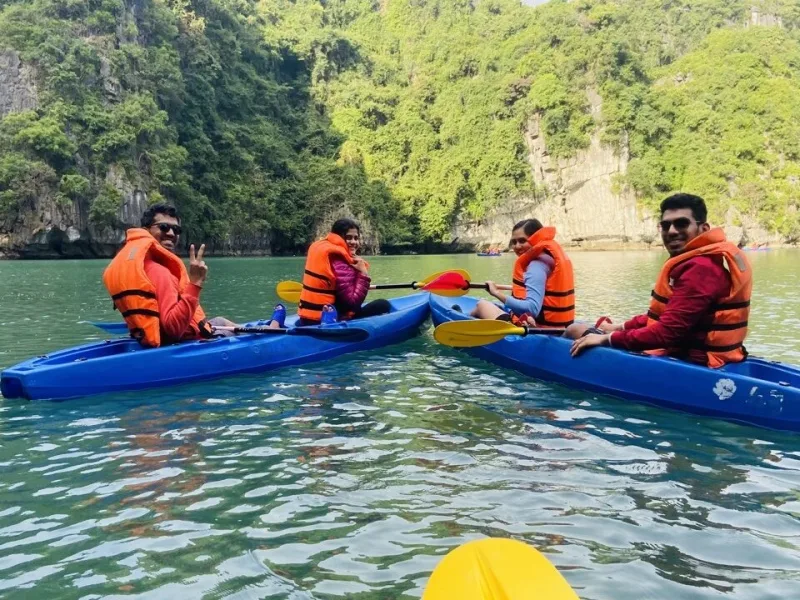
What you are paying for: a junk boat (traditional wooden cruise vessel) takes you through 1,600-plus limestone islands in the Gulf of Tonkin, with kayaking through sea caves, squid fishing at night, and a sunrise on the water that is genuinely hard to forget.
Cost ranges for 2026:
| Cruise Type | Per Person (2D1N) | Per Person (3D2N) |
|---|---|---|
| Budget junk cruise | Rs 8,000-11,000 | Rs 13,000-18,000 |
| Mid-range cruise | Rs 12,000-18,000 | Rs 20,000-30,000 |
| Premium (Indochine, Ambassador) | Rs 25,000-40,000 | Rs 40,000-65,000 |
Most Indian travellers prefer the 2-day/1-night format. Premium and mid-range cruises often include Indian vegetarian or Jain menu options on request. Budget cruises are more variable on food quality. Transfer from Hanoi to Got Pier (the main departure point, about 2.5 hours from Hanoi) costs Rs 1,500-2,500 per person.
On a group trip, cruise costs are typically bundled and the per-person rate comes down because the operator quotes for the full boat rather than individual cabins. Do not go below Rs 10,000 per person for the cruise itself if you care about the food and boat quality.
Hoi An and the Central Coast: 2-3 Days
After Halong Bay, most itineraries head south to Hue and Hoi An by train or flight. This stretch is the cultural heart of Vietnam and arguably the most photogenic part of the country.
Getting there: - Train (Hanoi to Da Nang, near Hoi An): Rs 1,200-3,500 depending on class. The Reunification Express overnight train is an experience in itself. - Flight (Hanoi to Da Nang): Rs 1,500-3,500 booked in advance.
Hoi An daily costs: - Mid-range guesthouse: Rs 1,800-3,500 per night - Cooking class with market tour: Rs 1,800-2,500 - Bicycle rental to explore the Old Town: Rs 200-350 per day - Custom tailored clothing: Rs 2,000-6,000 for a garment (Hoi An is famous for this, and the quality at mid-range tailors is genuinely good) - Hoi An Ancient Town heritage pass: Rs 420 (covers 5 sites)
The Hoi An night market is free to walk. Lantern-making workshops run Rs 350-600. Eating at hole-in-the-wall spots along the Thu Bon River is the cheapest and best dining in Vietnam.
Ho Chi Minh City: The Southern Finish Line
Ho Chi Minh City (still called Saigon by most locals) is where the north-to-south trip typically ends. It is bigger, faster, and more commercial than Hanoi.
Getting there from Hoi An/Da Nang: - Flight: Rs 1,500-4,000 (40 minutes, book in advance) - Sleeper bus (if time is not a constraint): Rs 700-1,200
HCMC daily costs: - 3-star hotel in District 1: Rs 3,000-6,000 per night - Street food (pho, banh mi, com tam): Rs 80-200 per meal - Cu Chi Tunnels half-day tour: Rs 1,200-2,000 per person - War Remnants Museum: Rs 350 entry - Mekong Delta day trip: Rs 1,500-2,500 per person - Ben Thanh Market: Free to enter, budget separately for shopping
Ho Chi Minh City is where Indian travellers often spend the most, partly because the restaurants and shopping are more tempting, and partly because it is the last stop. Budget accordingly.
How Much Should You Budget Per Day in Vietnam?
This is the number people actually want before booking:
| Travel Style | Daily Budget Per Person (on the ground, excluding flights and visa) |
|---|---|
| Backpacker | Rs 2,000-3,500 |
| Group trip (mid-range, shared stays) | Rs 3,500-5,500 |
| Comfort (3-4 star, restaurant meals) | Rs 6,000-9,000 |
| Luxury | Rs 12,000-20,000 |
On a 10-day trip, your on-ground spend before flights and visa sits at: - Backpacker: Rs 20,000-35,000 - Group mid-range: Rs 35,000-55,000 - Comfort: Rs 60,000-90,000
Add flights (Rs 25,000-40,000 from most Indian cities) and the visa (Rs 2,100) to get your total.
The Real Advantage of Travelling Vietnam as a Group
Vietnam works particularly well as a group destination because shared costs are significant and logistics are genuinely complicated. Internal transport, cruise bookings, and navigating four distinct cities all benefit from coordination.
With OJ, the Vietnam and Cambodia group trip bundles Halong Bay, internal transport, and accommodation. This means you avoid the most expensive mistake Indian travellers make: booking everything separately at tourist-facing rates. The group also means you have people to split a boat with, bargain at markets with, and eat at suspicious-looking but excellent street stalls with.
If you are weighing Vietnam against other Southeast Asian destinations, the Bali vs Vietnam comparison guide lays out the real differences in cost, experience, and what kind of traveller each suits better.
Best Time to Visit Vietnam From India: When to Go and When to Save
Vietnam's climate varies dramatically from north to south, which makes timing matter more than in most destinations.
| Month | North Vietnam | Central Vietnam | South Vietnam | Flight and Hotel Prices |
|---|---|---|---|---|
| Nov-Mar | Cool and dry (best) | Some rain | Hot and dry (best) | Moderate to high |
| Apr-May | Warm, some rain | Hot and dry | Hot and humid | Lower (shoulder) |
| Jun-Aug | Hot, rainy starts | Dry (beach season) | Rainy season | Cheapest |
| Sep-Oct | Typhoon risk | Typhoon risk, avoid | Drier | Cheapest flights |
The sweet spot for Indian travellers is November to February. The north is at its best, Halong Bay cruises run smoothly, and the weather is pleasant across the country. This overlaps with Indian winter break, so book flights early if you are travelling in December.
March and April offer shoulder-season prices with decent weather across most of the country. If you are planning a bigger international trip that month, the best time to travel internationally from India guide maps all major destinations against the Indian travel calendar so you can plan a full year ahead.
Mistakes That Blow the Vietnam Budget
A few common errors that inflate costs for Indian travellers:
Booking accommodation in the main tourist lane. The cheapest options sit one or two streets off the main drag at Rs 500-800 less per night. Over 10 days that is Rs 5,000-8,000 saved.
Underbudgeting for Halong Bay. The ultra-budget cruise boats (under Rs 7,000 per night) have inconsistent reputations on food hygiene and boat maintenance. Spend Rs 10,000-12,000 per person per night minimum for a clean, safe experience.
Not carrying local currency. Vietnam is largely cash-based, especially for street food, market shopping, and small transport. ATMs work fine with Indian debit and credit cards in Hanoi and Ho Chi Minh City. Carry Vietnamese dong; USD is accepted widely but at an unfavourable rate.
Missing the open-jaw flight option. Booking a return flight to one city and then paying for an internal one-way flight back is almost always more expensive than an open-jaw international ticket. Check before booking.
Frequently Asked Questions
Is Vietnam cheaper than Bali for Indians?
Do I need to apply for the Vietnam visa before leaving India?
What is the cheapest month to fly from India to Vietnam?
Is Halong Bay worth the price?
Can Indian vegetarians eat well in Vietnam?
Is Vietnam safe for Indian travellers?
One in the Orange Jacket runs offbeat group adventures for travellers who have outgrown the usual circuit.