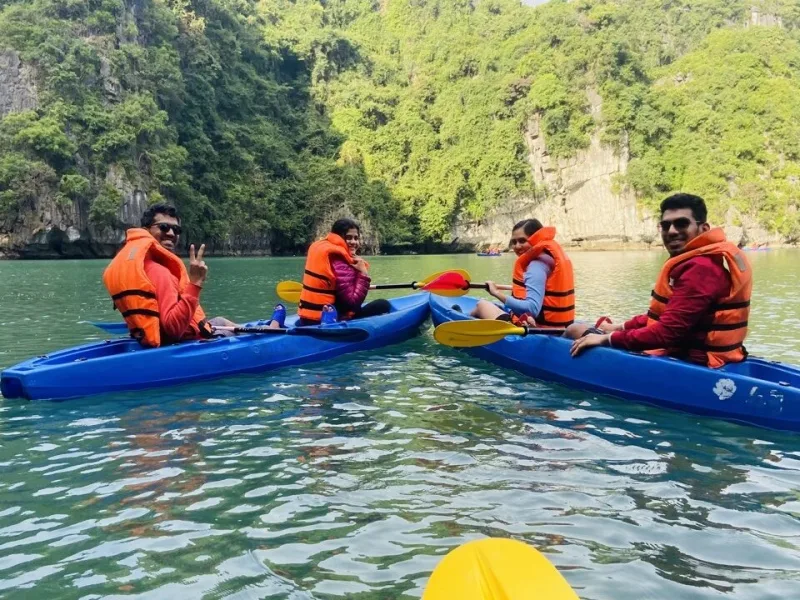
Most people doing a vietnam cambodia tour from india end up on a coach, filing past temples and ticking boxes. Twelve days, two countries, zero real memories. This post is for the ones who want the kayak into a hidden cave in Halong Bay, the 5 AM walk into Angkor Wat before the tour buses show up, and enough free time in Hanoi's Old Quarter to actually eat something they cannot name. Here is what a proper 12-day Vietnam and Cambodia group tour looks like, with realistic INR costs and the logistics that the package brochures leave out.
Why This Combination Works So Well
Vietnam and Cambodia are next-door neighbours that almost no Indian travel brand treats as a single trip worth doing well. Vietnam gives you varied terrain: limestone karsts over water, lantern-lit riverside towns, French colonial streets, war history, and food that will ruin you for everything else. Cambodia is one anchor: Angkor Wat. But what an anchor. The temple complex at Siem Reap is one of the genuinely unmissable things on earth, and landing there via Ho Chi Minh City by flight means you spend your Cambodia days at the temples, not on a bus.
The route that works for Indians flying out of Mumbai, Delhi, Bengaluru, or Kochi is north-to-south: arrive Hanoi, move through central Vietnam, exit from Ho Chi Minh City, fly into Siem Reap, fly home from Phnom Penh or Siem Reap. Every leg connects cleanly, internal flights are cheap, and you never backtrack.
The 12-Day Itinerary, Day by Day
This is the backbone. Times are approximate and can flex around group preferences.
Days 1-2: Hanoi Land at Noi Bai International Airport. Hanoi is the kind of city where you need to slow down, not speed up. The Old Quarter is 36 streets named after what was once sold on each one, and it still works like that in places. Walk the Hoan Kiem Lake loop in the evening. Eat bun cha (the grilled pork noodle dish) at a plastic-stool place off a side lane. Visit the Ho Chi Minh Mausoleum complex and the Temple of Literature the next morning.
Day 3: Halong Bay (overnight cruise) The drive from Hanoi to Halong is roughly 4 hours by road. Take it: the highway scenery is worth it. Board a junk cruise in the afternoon, kayak through limestone caves before dinner, sleep on the water. This is not optional on a Vietnam trip. No photograph does Halong Bay justice, and no coach-tour day trip captures it either. The overnight is the point.
Day 4: Halong Bay to Hanoi, fly to Da Nang Morning kayaking or a Tai Chi session on deck. Return to Hanoi, catch a 1.5-hour internal flight south to Da Nang. Transfer straight to Hoi An (30 minutes by road).
Days 5-6: Hoi An Hoi An is the Ancient Town: yellow walls, wooden merchant houses, lanterns over the Thu Bon River at night. It is also where you get clothes tailored overnight at prices that will make you regret not buying more fabric. Days here go: morning cycle through rice paddies, afternoon in the Old Town, evening at the lantern-lit market. No one has ever spent too much time in Hoi An.
Day 7: Da Nang, fly to Ho Chi Minh City Optional morning at My Son Sanctuary (Cham ruins, 4th to 14th century, genuinely impressive if you care about history). Then fly 1.5 hours south to Ho Chi Minh City.
Days 8-9: Ho Chi Minh City and Cu Chi Tunnels HCMC moves at a different pace from Hanoi. It is dense, fast, and loud in the best way. The War Remnants Museum is hard to look away from and essential. The Cu Chi Tunnels (70 km outside the city) put you underground in the Viet Cong tunnel network and make you understand how a guerrilla war was actually fought. Eat at Banh Mi Huynh Hoa, the benchmark banh mi shop that all others are measured against. The Ben Thanh Market area is fine for shopping; the Mekong Delta day trip (Ben Tre or Cai Be) is better if you have a free morning.
Day 10: Fly to Siem Reap, Cambodia The Saigon to Siem Reap flight is under an hour. Angkor Wat pass for 3 days costs USD 72. Pick it up at the ticket office the same afternoon if you arrive early enough. Evening in the Pub Street area is fine for one night; it gets old fast.
Day 11: Angkor Wat and Angkor Thom Start at 5 AM. This is non-negotiable. The sunrise at Angkor Wat reflected in the moat, before the coach tours pull in at 7:30, is one of the few things in travel that actually lives up to the hype. Angkor Thom, just north of the main temple, has the Bayon (the face towers, approximately 200 stone faces looking at you from every angle) and Ta Prohm, where the trees have grown through the temple walls. An afternoon rest is sensible; the heat is real.
Day 12: Banteay Srei, fly home Banteay Srei is a smaller temple 25 km from Siem Reap with intricately carved pink sandstone that the larger temples do not have. It opens at 7:30 AM. Do it before checkout, then head to the airport. Flights home typically connect through Bangkok, Kuala Lumpur, or Singapore.
What Does a Vietnam Cambodia Tour From India Actually Cost?
Prices below are per person for a 12-day trip, mid-range category, departing from major Indian cities.
| Cost Category | Budget Range (INR) | Notes |
|---|---|---|
| Return flights from India (to Hanoi, home from Siem Reap) | Rs 22,000 to Rs 45,000 | Delhi and Mumbai cheaper; Bengaluru and Kochi similar. Book 6-8 weeks out. |
| Internal flights (Hanoi to Da Nang, Da Nang to HCMC, HCMC to Siem Reap) | Rs 8,000 to Rs 18,000 | VietJet and Cambodia Angkor Air are the budget options |
| Accommodation (mix of 3-star hotels and one Halong overnight cruise) | Rs 12,000 to Rs 28,000 | Halong cruise alone is Rs 5,000 to Rs 12,000 per night per person |
| Vietnam e-visa | Rs 2,100 (USD 25) | Official portal: evisa.gov.vn |
| Cambodia e-visa | Rs 3,000 to Rs 3,500 (USD 36 incl. fees) | Official portal: evisa.gov.kh |
| Angkor Wat 3-day pass | Rs 7,200 (USD 72) | Official ticket counters at the complex; no third parties |
| Food (mix of street food and restaurants, per day) | Rs 800 to Rs 2,500 | Street food in both countries is excellent and safe |
| Tours, entrance fees, activities | Rs 5,000 to Rs 12,000 total | Cu Chi tunnels, kayak hire, My Son, Halong cave entry |
| Local transport (tuk-tuks, Grab, transfers) | Rs 2,000 to Rs 5,000 | Grab works in both Vietnam and Cambodia |
| Total estimate per person (12 nights, mid-range) | Rs 65,000 to Rs 1,20,000 | Group travel pulls the lower end down significantly |
If you are booking a group package through an Indian operator, expect all-inclusive 12-day packages (flights excluded) to start around Rs 55,000 to Rs 75,000 per person. If you are going with an OJ-style group where flights are booked independently and the ground operations are handled together, you land closer to Rs 80,000 to Rs 1,10,000 all-in, with much more flexibility on activities.
The detailed cost breakdown for Vietnam alone is worth reading separately: see Vietnam trip cost from India for a full breakdown by city and category.
Visa: What Indian Passport Holders Need for Both Countries
Neither Vietnam nor Cambodia requires you to visit a consulate. Both are handled online before you leave.
Vietnam e-visa: Apply at evisa.gov.vn. The e-visa costs USD 25 for single entry, USD 50 for multiple entry, and is valid for 90 days. Processing takes 3 to 7 business days. You need a passport-sized photo, a scan of your passport data page, and a card for online payment. Your passport needs 6 months validity from your arrival date and at least 2 blank pages. Apply at least a week before travel, not the night before.
Cambodia e-visa: Apply at evisa.gov.kh. The standard tourist e-visa costs USD 30 plus a USD 6 processing fee (total USD 36, roughly Rs 3,000 to Rs 3,500). Valid for 30 days from entry, single entry. Processing is 3 business days for standard, 24 hours for urgent service. You need a passport scan and a photo with a white background. Do not use third-party sites that charge significantly more; the official portal is straightforward.
Both visas are independent of each other. Apply for Vietnam first, then Cambodia, since you enter Vietnam first on this route. Keep digital copies of both approvals on your phone.
Flights From India: Routes and Realistic Prices
From Delhi, the best route is a direct or one-stop flight to Hanoi (Noi Bai, HAN). IndiGo, Air India, VietJet, and Vietnam Airlines all operate this route. Direct flights run 4.5 to 5 hours. Prices start around Rs 13,000 to Rs 15,000 one-way in economy; expect Rs 22,000 to Rs 30,000 for a decent round-trip booked 6 to 8 weeks out.
From Mumbai, connections through Kuala Lumpur (AirAsia or MAS) or Bangkok (Thai Airways, IndiGo) add 2 to 3 hours. Budget around Rs 25,000 to Rs 38,000 return.
From Bengaluru and Kochi, routes through Kuala Lumpur or Singapore work well. Bengaluru to Hanoi via KL is around Rs 25,000 to Rs 42,000 return. Check fares on Google Flights or Kayak and compare dates before booking.
For the return leg, Siem Reap to India via Bangkok or Kuala Lumpur is typical. Alternatively, fly to Phnom Penh (PNH) first and get a better-connected flight home; Phnom Penh has more international frequencies.
Best Time to Do This Trip From India
November to March is the window where both Vietnam and Cambodia behave themselves. Specifically: - November to February: Dry and cool across Cambodia, dry season in northern Vietnam (Hanoi, Halong) and southern Vietnam (HCMC). Central Vietnam (Hoi An) can see some rain through November but clears up by December. - February to March: Slightly fewer crowds than December-January, warm enough to be pleasant, cheap enough to be a relief after the peak season rates.
Avoid April (Cambodia hits 40 degrees C, brutal for temple walking) and July to September (typhoon risk in central Vietnam, heavy rain across Cambodia).
The Indian winter break, specifically late December to early January, aligns with peak season in both countries. Prices and crowds reflect that. If you can travel in November or February instead, you will have better value and shorter queues at Angkor Wat. That said, December-January works fine if you book accommodation and Angkor passes well in advance.
Halong Bay vs. a Day Trip: Why the Overnight Matters
Almost every Indian who does Vietnam and Cambodia and later says the trip felt rushed made one specific mistake: they took a day trip to Halong Bay from Hanoi instead of booking an overnight cruise.
Halong Bay has 1,969 islands and limestone karsts. A day trip shows you maybe 5 of them, from a boat, in the middle of peak traffic hours on the water. An overnight cruise gives you kayaking through caves at dawn, sunset on the upper deck with the silhouettes of the karsts going dark, and a morning on the bay that is genuinely quiet. The difference in cost is roughly Rs 3,500 to Rs 8,000 per person. The difference in experience is the reason people remember Halong Bay for the rest of their lives.
If your Vietnam Cambodia itinerary has Halong as a day trip, push back on it. If an operator tells you the overnight is unnecessary, they are either cutting costs or they have never done it themselves.
Angkor Wat: How to Not Waste It
Angkor Wat is the largest religious monument on earth. It is also perpetually overrun by 2 PM. Here is how to do it properly:
Start at Angkor Wat itself for the sunrise (5:00 to 5:30 AM entry). The reflection in the moat in the pre-dawn light with only other early risers around you is the image. Once the sun is up fully and the coach buses park at 7 AM, move to Angkor Thom (the walled city, 1.2 km north). Spend the morning there: the Bayon temple with its 54 towers and 216 stone faces is remarkable, and Ta Prohm (the "Tomb Raider" temple, where strangler figs have consumed the walls) is genuinely eerie.
The Angkor complex covers 400 square kilometres. A tuk-tuk driver for the day costs roughly Rs 1,200 to Rs 1,800 and is the best way to move between temples. Hire one through your accommodation; the unofficial tuk-tuk drivers outside the gate will charge twice as much.
Drink water constantly. The Cambodia sun in the dry season is serious.
Food: What Indians Actually Eat in Vietnam and Cambodia
This is a real concern for Indian travellers because both countries are heavily meat and seafood-based, and pork is ubiquitous.
Vietnam: Vegetarians have the hardest time in Hanoi, where broth is almost always meat-based even when a dish looks vegetarian. Hoi An is better (there is a Buddhist vegetarian restaurant tradition in central Vietnam). Ho Chi Minh City is easiest: find any restaurant with a "chay" (vegetarian) menu. Vegan options exist in all three cities if you know where to look, though asking restaurants to customise is more effective than looking for dedicated vegan spots.
For non-vegetarians, you are in food paradise. Pho, bun cha, banh mi, cao lau in Hoi An, and com tam (broken rice) in Saigon are all essential. The food is cheap: a full meal at a good street restaurant costs Rs 200 to Rs 500.
Cambodia: Khmer cuisine leans on fish, pork, and chicken, often with lemongrass and coconut milk. Amok (a fish curry steamed in a banana leaf) is the national dish and is genuinely good. Vegetarian options are limited outside tourist-facing restaurants in Siem Reap. Pub Street in Siem Reap has enough Indian and pan-Asian restaurants to keep everyone fed.
Indians travelling with groups generally find that a shared meal philosophy works better than individual restaurant hunting. Agree on a few good options each day and split the cost; it saves decision fatigue and keeps the group together.
Group Travel for This Route: Why It Makes Sense
A Vietnam Cambodia trip independently is completely doable, but it involves a lot of moving parts: internal flights booked separately, hotels in five different cities, a Halong Bay cruise operator to vet, Angkor Wat logistics, tuk-tuk drivers in two countries, and meal decisions every day. For first-timers or anyone who does not want the planning to become a second job, a group trip with a fixed itinerary removes most of that.
The other argument for groups is the social experience of temples at 5 AM. Angkor Wat at sunrise with people you have been travelling with for a week is a different thing from experiencing it with strangers or alone. OJ runs this exact route with small groups of like-minded 20s and 30s. There is enough structure to make the logistics easy and enough flexibility that you are not following a flag through a museum.
For a comparison of Vietnam solo versus group travel economics, the bali vs vietnam for indians post covers the cost angles in detail. And if you are weighing Southeast Asia against other international trips, the best summer trips from India for groups overview puts Vietnam Cambodia in context against other routes Indian travellers are doing right now.
Things That Will Catch You Off Guard
A few things that the standard tour itinerary mentions only in passing:
The heat. Cambodia in February is 30 to 33 degrees. Budget for a break in the middle of the day and do temple walks in the early morning and late afternoon. Cotton clothes, sunscreen, and a sun hat are not suggestions.
The traffic in Vietnamese cities. Ho Chi Minh City traffic is a functioning ecosystem of motorbikes that follows rules not immediately obvious to an outsider. Walk confidently and steadily; the bikes will weave around you. Do not stop suddenly in the middle of the road. It sounds chaotic and it is, but it works.
Currency. Vietnam uses Vietnamese Dong (VND); Cambodia uses US dollars widely, and USD is accepted almost everywhere in Siem Reap. Keep small USD bills (1s and 5s) for tuk-tuks and temple entry. Indian credit cards (Visa, Mastercard) work at ATMs and major hotels in both countries.
SIM cards. Buy a local Vietnamese SIM at Noi Bai Airport on arrival (costs Rs 400 to Rs 600 for 10 to 15 days of data). Switch to a Cambodian SIM in Siem Reap if needed, though most hotels have functional Wi-Fi. Grab app works in both countries for rides.
Frequently Asked Questions
Is a combined Vietnam and Cambodia tour worth it compared to doing one country at a time?
Do Indian passport holders need a visa for Vietnam?
Do Indian passport holders need a visa for Cambodia?
What is the best time to go from India?
Can vegetarian Indians manage food in Vietnam and Cambodia?
What should Indians know about money in Vietnam and Cambodia?
If you want a small-group Vietnam and Cambodia trip that covers Halong Bay kayaking, Hoi An, Ho Chi Minh City, and Angkor Wat with fellow Indians who are done with coach tours, look at the OJ Vietnam and Cambodia group trip.
One in the Orange Jacket runs offbeat group adventures for travellers who have outgrown the usual circuit.