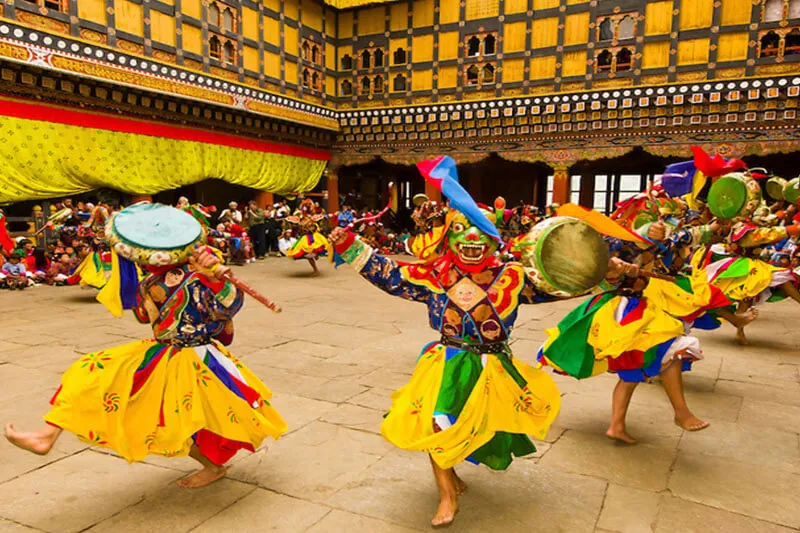
In Bhutan, the happiest country to measure happiness, the great religious festivals called tshechus are the beating heart of the year, and the Paro Tshechu is among the most beloved of all. For several days each spring, the courtyards of the magnificent Paro dzong fill with masked sacred dances, and the whole valley gathers in its finest dress to watch, pray, and celebrate. It culminates in a single dawn moment so sacred that simply seeing it is said to cleanse a lifetime of sin.
A festival of sacred dance
A tshechu is a religious festival held in honour of Guru Rinpoche, the eighth-century saint who brought Buddhism to Bhutan, celebrated on the tenth day of a lunar month, which is what tshechu means. Its centrepiece is the cham, masked dances performed by monks in spectacular, elaborate costumes and carved masks, each dance enacting a story from Buddhist teaching, the triumph of good over evil, the judgement of the dead, the deeds of the saints. These are not performances for entertainment but acts of worship, and watching them is believed to bring blessings and merit to all present.
Between the solemn dances, masked clowns called atsaras weave through the crowd, mocking, joking, and teasing, a thread of comedy that lightens the sacred proceedings and is loved by all. The whole community attends, dressed in their finest traditional gho and kira, and the festival is as much a great social gathering, a reunion of families and valleys, as it is a religious one.
A tshechu is not a show with a religious theme. The dances are the worship, and to watch them is itself an act of devotion that earns merit.
On the cham
The thongdrel: the moment a glance cleanses
The climax of the Paro Tshechu comes on the final morning, before dawn, with the unfurling of the thongdrel, a vast appliqued silk scroll, a thangka so enormous it covers an entire wall of the dzong, depicting Guru Rinpoche. It is displayed only in the early hours and rolled away before the sun's rays can touch it. The belief gives the moment its power: simply to gaze upon the thongdrel is said to cleanse the viewer of sin and bring liberation. The word itself means, roughly, liberation on sight.
Thousands gather in the dark and the cold to receive this blessing, a deeply moving collective act of faith as the great image is revealed in the lamplight. It is the most sacred moment of the festival and one of the most powerful religious experiences a visitor to Bhutan can witness, a whole valley rising before dawn to be cleansed by a single glance.
How to attend respectfully
- Dress respectfully. Bhutan asks for modest, covered dress at dzongs and festivals. Long sleeves and long trousers or skirts; no hats inside the dzong.
- Be an unobtrusive guest. This is sacred worship, not a tourist show. Sit where directed, stay quiet during dances, and do not block locals' view.
- Ask about photography. Photographing the cham dances is usually allowed, but the thongdrel and certain moments may not be. Always check and respect the rules.
- Rise early for the thongdrel. The great scroll is shown only before dawn on the final day. It is cold and crowded, and it is the heart of the festival.
- Remember Bhutan's tourism model. Visits are arranged through the country's controlled, guided system, so a festival visit is planned in advance with local guides.
The soul of Bhutan in a few days
To attend a tshechu is to see Bhutan as it sees itself: devout, joyful, communal, and deeply rooted in a living Buddhist faith that shapes everything from the architecture to the national philosophy. Far from the curated experiences most countries offer tourists, the tshechu is the real thing, an authentic act of collective worship and celebration that the Bhutanese hold dearer than anything. To witness it, respectfully and quietly, is to be allowed a glimpse into the spiritual life of one of the last Buddhist kingdoms on earth.
Bhutan does not stage its festivals for visitors. The tshechu is for the gods and the valley, and the traveller is simply, graciously, allowed to be present.
On the OJ Paro Tshechu trip we time the journey to one of Bhutan's most sacred celebrations, the masked dances in the dzong courtyard, the community in its finest, the dawn unveiling of the great thongdrel. Because the monasteries clinging to cliffs and the valleys of the dragon kingdom are extraordinary at any time, but to be there during the tshechu, among a whole people at worship and celebration, is to feel the soul of Bhutan rather than simply admire its surface.
Frequently asked
What is the Paro Tshechu?
The Paro Tshechu is one of Bhutan's most important and beloved religious festivals, held over several days in spring at the Paro dzong in honour of Guru Rinpoche, who brought Buddhism to Bhutan. Its centrepiece is the cham, sacred masked dances performed by monks, and it culminates in the dawn unveiling of a giant sacred scroll, the thongdrel.
What is the thongdrel?
The thongdrel is an enormous appliqued silk scroll, a thangka depicting Guru Rinpoche, so large it covers an entire wall of the dzong. It is unfurled only before dawn on the final morning of the tshechu and rolled away before sunlight touches it. Bhutanese believe that simply seeing it cleanses the viewer of sin, the meaning of its name, liberation on sight.
How should visitors behave at a Bhutanese tshechu?
Dress modestly with covered arms and legs and no hats inside the dzong, sit where directed, and stay quiet and unobtrusive during the sacred dances, since this is worship, not a show. Always check photography rules, as the thongdrel and some moments may be off-limits. Rise early for the dawn thongdrel, the heart of the festival.